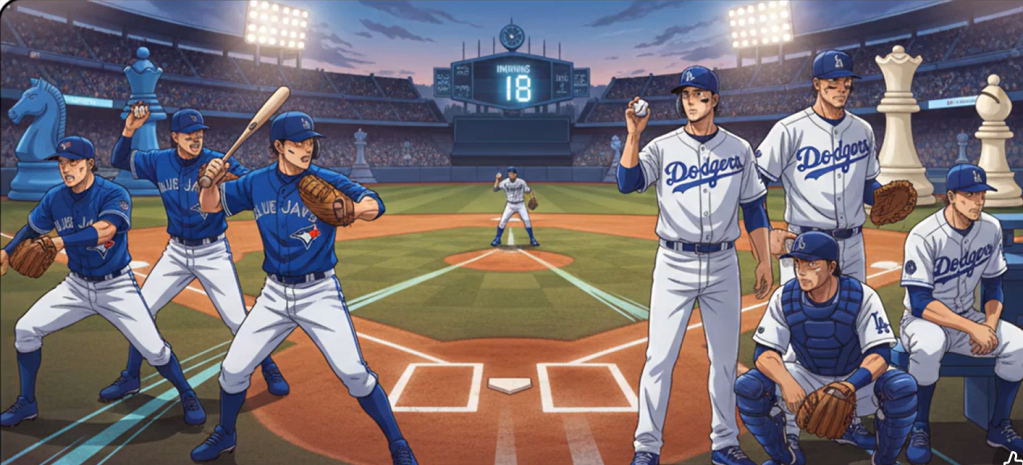
In the previous piece (“World Series G3 Postgame Breakdown, Part 2/3”), we dug into bullpen usage, hitting, baserunning, and defense for both the Blue Jays and Dodgers in this 18-inning epic.
In this Part 3/3, we shift up a level to the tactical layer—how each dugout managed the game, the logic behind their moves, and how those choices shaped the marathon.
We then preview probable Game 4 (G4) starting pitchers and potential lineup tweaks, and wrap with a series-wide read after three games.As the World Series enters its tight, mid-series phase, how both sides adjust will be pivotal to where this matchup goes next.
9️⃣ Coaching staffs: tactics and game management
This game went to the 18th, lasted 6 hours 39 minutes, and finally ended on a late extra-innings solo shot by “the Freeman” Freddie Freeman, giving the Dodgers a 6–5 win. In a contest this long and tense, managerial decisions are the center of gravity—tiny choices, tiny edges, that can tilt an entire night.
(Blue Jays: tactics & usage)
Toronto’s starting order was set with RHP Tyler Glasnow in mind and looked similar to Game 2. The biggest change: Bo Bichette, just back from injury, returned to the lineup.
That choice required careful thought from manager John Schneider. Bichette posted a 134 wRC+ and a .311 AVG in the regular season—core production. But playing through incomplete recovery can sap output and risk aggravation, with spillover to the rest of the Series.
Schneider nonetheless started Bichette—and batted him fourth. While many managers now push top bats to the 1–3 spots to spike first-inning run expectancy, the cleanup role still carries protection and middle-of-the-order leverage—especially in a war of attrition like this.
Versus Glasnow, Toronto’s approach discipline and balanced contact across the order paid off the second time through: they pounced when his feel wobbled, and aided by a Dodgers misplay, hung a four-spot to seize momentum.
On the mound, Schneider’s timing was assertive. Max Scherzer started and, in the fifth with one out and a man on, was set to face the order a third time—beginning with Shohei Ohtani, who had already doubled and homered. Schneider refused the third look and went to LHP Mason Fluharty.
Fluharty didn’t get Ohtani or Freddie Freeman (both RBI knocks that tied it), but the choice still reflects platoon-forward, matchup-bold thinking.
Beyond that, Toronto pushed the “A” relievers early—Seranthony Domínguez, Jeff Hoffman, etc.—to stabilize the game. Even after Ohtani’s seventh-inning game-tying homer, the pen overall kept it level to extras.
Crucially, once Ohtani logged four straight extra-base hits, the Jays shifted to near-automatic IBBs from the ninth on—minimizing walk-off risk. That choice meshed with the backstop: Mookie Betts was scuffling, making him a tolerable tradeoff. In one sequence they even walked into a bases-loaded, two-out spot to let LHP Eric Lauer face the lefty Freeman, chasing a force at any base; it worked.
Though Toronto’s regular-season baserunning (BsR −5.6, 25th) was poor, they acted aggressively as the road team in extras, using three pinch-runners—well above Schneider’s regular-season norm (0.21 PR per game; league ~0.19). Even with modest team speed, the staff tried to manufacture the go-ahead run with legs.
The cost of the night was real: a 5–6 loss, an aggravation to leadoff man George Springer (ab strain; exited early), and nine pitchers used (eight relievers). With the pen heavily taxed, Shane Bieber’s ability to cover innings in G4 loomed as a swing factor.
(Dodgers: tactics & usage)
L.A. ran the same nine as in Games 1 and 2 but swapped slots to create a left-right “zig-zag”: in spots 1–8, odd slots left-handed (including switch-hitter Tommy Edman, who batted left vs. RHP Scherzer), even slots right-handed. The idea: blunt platoon bullpen leverage—a Dave Roberts staple.
The Dodgers struck early on Scherzer: Teoscar Hernández opened with a solo shot in the second (1–0), Ohtani added a solo in the third (2–0), and in the fifth they exploited wildness and traffic to pull a 2–4 deficit back to 4–4.
They again hit Ohtani leadoff. His four early extra-base hits validated the modern “nuclear leadoff” concept—give your best overall bat the most PAs.
Personnel moves leaned more toward defensive matchups than pinch-running. Edman slid to center, Kiké Hernández gave way to Miguel Rojas for small-ball situations, and Andy Pages ceded LF to Alex Call after struggling at the plate.
Not every tweak landed; the offense stalled into extras. Ultimately, Freeman’s 18th-inning blast broke through—it was a grind, not a breeze.
On the mound, the bullpen architecture worked: from the fifth through the 18th they allowed just one run. Still, a few choices ran hot:
• 12th-inning, bases loaded: the Dodgers summoned Clayton Kershaw—velo down, but left-on-left vs. Nathan Lukes made matchup sense. Risky, yes; it worked (key groundout).
• RHP Will Klein was a revelation—four innings, 72 pitches, well beyond any regular-season workload. Necessity in extras, and he answered—an unsung hero who may alter how the club views his 2026 role.
The win extracted a heavy toll: 10 pitchers used (nine relievers)—nearly the entire bullpen. And G4 brings Shohei Ohtani to the mound after he played all night as the DH and leadoff with four XBH—fatigue risk. Ohtani’s routine depends on sleep, and a deep, late finish could pinch recovery.
Counterpoint: his last start (NLCS G4 vs. the Brewers) showed dominant stuff and readiness. Even on a quick turn under stress, he may be primed. With the bullpen gassed, a lot rides on his shoulders.
🔟 G4: projected starters & likely adjustments
First pitch (Taipei): Oct 29, 8:00 a.m.
Probables: Shane Bieber (TOR) vs Shohei Ohtani (LAD)
This is Ohtani’s first World Series pitching start. He appeared in the 2024 Fall Classic as a DH only while rehabbing his elbow; now, post-surgery, he finally takes the World Series mound.
Given Toronto’s disciplined offense and the long G3, how Ohtani manages energy and tempo is a headline storyline.
On the other side, it’s also Bieber’s first WS appearance. Across his three 2025 postseason starts he has 12.1 IP, 16 H, 7 R (6 ER), 15 K, 3 BB, 4.38 ERA—swingy, with only one start of 6.0 IP/2 ER (ALCS G3 vs. SEA). The other two were <4.0 IP. With Toronto down 1–2 and their bullpen spent, Bieber’s ability to stabilize and absorb innings is paramount.
Ohtani (postseason to date): 12.0 IP, 5 H, 3 ER, 19 K, 4 BB, .128 BAA, 2.25 ERA—overpowering. Split-wise in 2025: vs LHB .179 / .422 OPS, vs RHB .265 / .693 OPS—stronger suppression of lefties. The Jays’ core skews right-handed, potentially a lineup edge, yet Ohtani’s whiff vs RHB is 34.0% on sweeper + four-seam, both >30% whiff; vs LHB he leans fastball with a mixed arsenal (30.9% whiff). Bottom line: he can neutralize both sides; the Jays need to disrupt his pitch-shape rhythm by handedness.
Bieber: 12.1 IP, 16 H, 6 ER (7 R), 15 K, 3 BB. Notable splits:
• vs LHB: .156 AVG / .435 OPS (excellent)
• vs RHB: .297 AVG / .937 OPS (vulnerable)
That’s a green light for the Dodgers to stack righties. Usage diverges by side:
• vs RHB: slider-heavy (36.1%), very little changeup (8.2%).
• vs LHB: more four-seam (37.4%) and knuckle-curve (25.5%), slider rare (5.2%).
Given the G3 bullpen drain, the starter who goes deeper is the likely separator. Bieber vs Ohtani is as much a test of endurance and in-game sequencing as raw stuff.
1️⃣1️⃣ Takeaways & outlook
G3 was an instant classic: 18 innings, Ohtani reaching in all nine plate appearances, and the Jays trading punches into the small hours before Freeman ended it with a walk-off in the 18th.
A coda worth noting: legendary lefty Clayton Kershaw, nearing the end of his career, stepped into a landmine inning and defused it—a late-career image with real symbolic weight.
From a historical lens, this game evokes the 2018 WS G3, when the Dodgers beat the Red Sox in 18 on Max Muncy’s walk-off off Nathan Eovaldi—and for Taiwanese fans, memories of the 2009 CPBL Taiwan Series G6, when the Brothers and Uni-Lions fought to the 17th and Sheng-Wei Wang homered off veteran reliever Chien-San Kao to force a Game 7 (with today’s epilogues: Wang still active with the Fubon Guardians, Kao now coaching the TSG Hawks, founded in 2022). The Lions ultimately won, but that game etched itself into memory.
So 2025 WS G3 is not only a new MLB milestone—it also resonates with shared memories of extra-innings epics across leagues.
We’ll pause this postgame here. G4 brings Bieber vs Ohtani, both first-time World Series starters—must-watch theater. The next piece will break that matchup down in detail. Stay tuned.
Sources /
MLB App
MLB.com
Baseball-Reference
FanGraphs
Wikipedia
CPBL official site
Taiwan Baseball Wiki
P.S. Thanks to friends in our baseball group for some of the pointers.
 A Fan's MLB Insight
發表留言