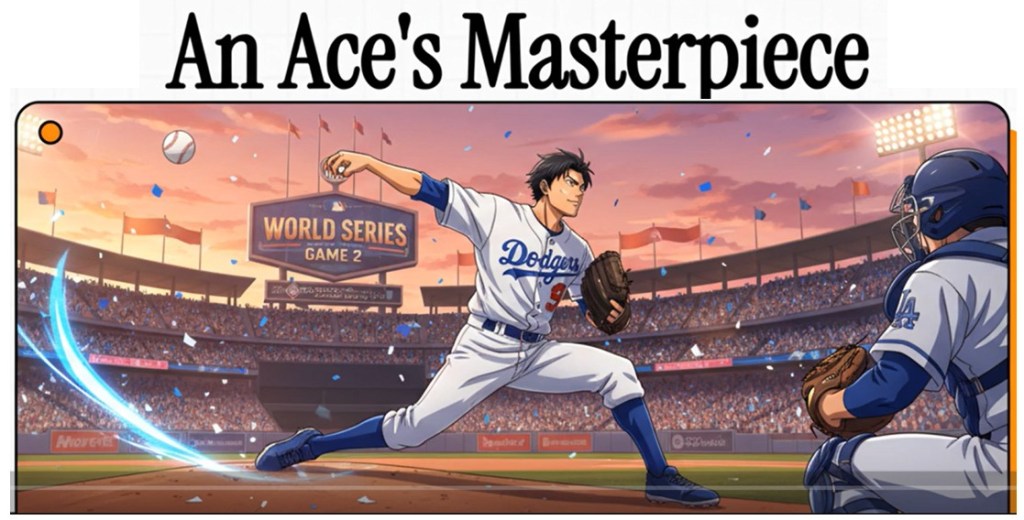
This game was Game 2 of the 2025 MLB World Series.
After dropping Game 1 by a score of 1–4, the Los Angeles Dodgers sent out their most trusted arm of the season, Yoshinobu Yamamoto, hoping to even the series and avoid falling into a 0–2 hole. On the other side, the Blue Jays looked to lean on their ace Kevin Gausman to secure a 2–0 start at home.
Yoshinobu Yamamoto was the Dodgers’ workhorse this year. He led all Dodgers starters in innings pitched (173.2 IP), went 12–8 with a 2.49 ERA, and struck out 201 batters (K% 29.39%). His command was excellent: a 3.41 K/BB ratio and a .183 opponent batting average show elite-level run suppression.
Kevin Gausman was just as crucial for Toronto. He led the entire Blue Jays staff in innings (193 IP), went 10–11 with a 3.59 ERA, struck out 189 (K% 24.39%), had a 3.78 K/BB ratio, and held opposing hitters to a .216 average. These are ace-quality numbers.
In short: both Yamamoto and Gausman are elite tempo-setters. They throw strikes, their stuff plays, and they stabilize the game for their teams. But neither pitcher’s win–loss record looks dominant, and that’s largely because of run support rather than true performance. Yamamoto’s run support averaged just 3.52 runs per start; Gausman’s was 4.38. In other words, their “true value” is a lot higher than the win totals suggest.
The Dodgers struck first in the top of the 1st. With two outs, Freddie Freeman ripped a double, and Will Smith followed with a timely RBI hit with a runner in scoring position. That made it 1–0 Dodgers. Yamamoto, meanwhile, found immediate trouble in the bottom of the 1st — runners on first and third, none out — but he quickly settled in and pitched out of it without allowing a run.
In the bottom of the 3rd, the Blue Jays answered. Leadoff man George Springer reached on a hit-by-pitch, and with one out, Vladimir Guerrero Jr. (“Vladdy Jr.”) singled to push runners to the corners. Catcher Alejandro Kirk then lifted a sac fly to center to tie the game 1–1.
From the 4th through the 6th, both teams were locked in a pitcher’s duel. No one could push across the go-ahead run. But in the top of the 7th — against Kevin Gausman, who had retired 17 straight hitters up to that point — Will Smith finally broke through. He crushed a solo homer to center to give L.A. a 2–1 lead. Max Muncy followed with another solo shot, and the Dodgers stretched it to 3–1.
In the top of the 8th, the Dodgers piled on against Toronto’s late-inning relief crew (Louis Varland, then Jeff Hoffman). A string of base hits, a walk, a wild pitch, and a slow infield roller that acted like a guided run delivery pushed the lead to 5–1.
On the mound, Yamamoto was nearly untouchable after the 3rd. He shut Toronto down completely the rest of the way, denying them any meaningful traffic. The Dodgers won 5–1 and, most importantly, tied the series.
We’ve also included highlight footage from this game.
Video courtesy of MLB’s official YouTube channel.
Below is the outline for this two-part World Series G2 breakdown (10 sections total):
Part 1: Game Flow and Pitching Performance
1️⃣ Starting lineup strategy for both teams
2️⃣ Blue Jays SP Kevin Gausman – performance breakdown
3️⃣ Dodgers SP Yoshinobu Yamamoto – performance breakdown
4️⃣ Bullpen usage and relief pitching from both clubs
Part 2: Tactics, Aftermath, and Series Outlook
5️⃣ Offensive production for both lineups
6️⃣ Baserunning
7️⃣ Defense
8️⃣ Dugout / coaching decisions and in-game tactics
9️⃣ Projected Game 3 starters and likely lineup adjustments
🔟 Final takeaways going forward in the series
With that, let’s revisit Game 2 — a very different kind of story than Game 1:
a pure pitcher’s duel, controlled by elite starters. This is the postgame dissection of a game ruled by arms.
1️⃣ Starting Lineup Strategy
(Los Angeles Dodgers Lineup)
The Dodgers’ Game 2 starting lineup:
LOS ANGELES DODGERS
1 DH Shohei Ohtani (L)
2 SS Mookie Betts (R)
3 1B Freddie Freeman (L)
4 C Will Smith (R)
5 RF Teoscar Hernández (R)
6 3B Max Muncy (L)
7 LF Kiké Hernández (R)
8 2B Tommy Edman (S)
9 CF Andy Pages (R)
SP Yoshinobu Yamamoto (RHP)
The Dodgers’ starting order was almost identical to Game 1. The only “change” is the obvious one: the starting pitcher was Yamamoto instead of Snell. Otherwise, Dave Roberts essentially rolled out the same core group. That tells us a few things:
Toronto’s Game 2 starter Kevin Gausman, like Game 1 starter Trey Yesavage, is a right-hander. This lineup is clearly the Dodgers’ preferred “vs RHP” configuration. Even though the offense didn’t really string things together in Game 1, the staff treated that as an off night, not a structural flaw that required a reshuffle.
Looking closer at roster construction: among the Dodgers’ 14 position players on this World Series roster, only five are true left-handed hitters. Tommy Edman is a switch-hitter. In Game 1, Edman batted right-handed because Toronto started Yesavage, whose splitter profiles as unusually effective versus lefties — i.e., Yesavage “plays like a lefty killer,” so hitting right-handed gave Edman the better matchup.
But the Dodgers’ real left-handed thump is concentrated in just three names:
- Shohei Ohtani
- Freddie Freeman
- Max Muncy
The other lefties — Hyeseong Kim and Ben Rortvedt — are more in bench / matchup roles. Offensively, they don’t yet displace guys like Edman or Will Smith. That means the Dodgers can’t endlessly reshuffle to create a fully left-heavy attack; they just don’t have that many high-leverage lefty bats to swap in.
So against a righty-heavy Toronto staff, the Dodgers prioritized stability over panic. Rather than scramble the order, they doubled down on execution and timing adjustments.
(Toronto Blue Jays Lineup)
TORONTO BLUE JAYS
1 DH George Springer (R)
2 LF Nathan Lukes (L)
3 1B Vladimir Guerrero Jr. (R)
4 C Alejandro Kirk (R)
5 CF Daulton Varsho (L)
6 3B Ernie Clement (R)
7 RF Addison Barger (L)
8 2B Isiah Kiner-Falefa (R)
9 SS Andrés Giménez (L)
SP Kevin Gausman (RHP)
Toronto, by contrast, made significant changes from Game 1. Aside from a few fixtures — Springer still led off as DH, Guerrero Jr. stayed in the 3-hole at first base, and Andrés Giménez stayed in the 9-spot at short — six other spots shifted.
Why the shakeup? Game 1 starter for the Dodgers was left-hander Blake Snell, so in Game 1 the Jays parked some of their lefty corner outfield bats (Nathan Lukes and Addison Barger). But in Game 2 the Dodgers started right-hander Yamamoto, so Toronto reinserted them:
- Lukes hit second and played LF
- Barger hit seventh and played RF
That gave Toronto more left-handed looks against Yamamoto, theoretically widening their angles of attack.
There was also a health piece: Bo Bichette, who hit cleanup and played second base in Game 1, was not fully recovered and did not start in Game 2. To cover that loss, the Jays slid Alejandro Kirk, Daulton Varsho, and Ernie Clement up into the 4–5–6 range to keep some punch in the middle.
Second base went to Isiah Kiner-Falefa (IKF), who hit eighth and brought defensive stability plus situational flexibility.
Net effect:
– More lefties in the lineup ⇒ a better chance to bother Yamamoto’s command patterns.
– Enough middle-order output even without Bichette ⇒ no gaping hole in the 4–6 spots.
– Defense stays steady ⇒ IKF shores up the infield.
In other words, Toronto essentially toggled into their “vs RHP” build, a different configuration than Game 1, tailored specifically for Yamamoto.
2️⃣ Blue Jays SP Kevin Gausman – Game 2 Breakdown
(Stat Line Overview)
Blue Jays starter Kevin Gausman threw 6 2/3 innings. He allowed 4 hits and 3 earned runs, struck out 6, and issued no walks or HBPs. He threw 82 pitches, 59 for strikes — a 71.95% strike rate — and for most of the night he controlled the tempo beautifully.
But the game turned right as he hit the fatigue wall. In the 7th inning, with his pitch count climbing, he was tagged for back-to-back solo homers. Those two swings became the pivot point of the entire game.
It’s worth noting how he responded to early turbulence. In the top of the 1st, with two outs, Freddie Freeman and Will Smith produced back-to-back hits to push across the first Dodgers run. After that, Gausman locked in. He proceeded to retire 17 straight batters and didn’t allow another baserunner until the 7th. That next baserunner? Will Smith again — and this time it left the yard to break a 1–1 tie.
So Gausman essentially pitched the textbook “ace outing with one bad inning”: dominant command, elite sequencing, total control — but two mistakes in crunch time stole the win out of his hands.
(Pitch Mix and Pitch Quality)
Kevin Gausman used three pitches in this game:
Four-seam fastball (49 thrown) – 59.76% usage
Splitter (29 thrown) – 35.37% usage
Slider (4 thrown) – 4.88% usage
⚾️ Gausman – Four-seam Fastball ⚾️
Gausman actually leaned on his fastball more than usual. He threw it nearly 60% of the time (his season average was around 53.7%), so that’s roughly a +6 percentage point bump. He clearly wanted to attack the zone, challenge hitters up, and get ahead early.
Even deep into the game he held his velocity. He was still sitting 94–95 mph in the later innings, showing no obvious drop-off. That endurance is what allowed him to keep using the heater aggressively even the third time through the order. His fastball strike rate was an absurd 86%. Location-wise, he consistently hit the targets set by Alejandro Kirk — in, out, up, down — which is why the Dodgers’ bats went so quiet for so long.
⚾️ Gausman – Splitter ⚾️
The splitter is Gausman’s signature weapon. He threw it 35.4% of the time in this game (just a tick below his season rate of ~37.6%), and it was as nasty as ever. All season long, hitters batted just .181 against it with a 38.6% whiff rate. It destroys both lefties and righties.
In Game 2 it was even filthier: 13 splitters generated 8 whiffs — a 61.5% whiff rate. Of his 6 strikeouts, 5 came on the splitter. He repeatedly buried it just under the bottom edge of the zone, in that “maybe strike, maybe ball” tunnel. Dodgers hitters chased it because it looked hittable out of the hand and then just… vanished.
⚾️ Gausman – Slider ⚾️
The slider was essentially shelved. He threw just 4 sliders (4.9% usage), down from his season average of 8.6% — about a 3.7-point dip. Typically, he uses the slider more versus righties (13.3% usage in the regular season) than versus lefties (3.2%). And the Dodgers’ order in this game leaned right-handed, so in theory that slider should’ve shown up more. Instead, after the first trip through the lineup, he barely used it at all.
That tells us the plan: live and die with high fastballs and low splitters. Ride vertical separation. Force hitters to cover both top and bottom of the strike zone and guess which plane to commit to. That two-pitch tunnel worked brilliantly… right up until it didn’t in the 7th.
(Gausman + Alejandro Kirk: Inning-by-Inning Sequencing)
Top 1st
In the 1st, Gausman and Kirk used a broad mix. The only hitter who saw basically nothing but heaters was Shohei Ohtani; everyone else — Mookie Betts, Freddie Freeman, Will Smith, Teoscar Hernández — got fastball/change of speed blends.
The early game plan was clear: avoid giving up extra-base damage. Almost everything was kept down or at the bottom edge. The goal was to induce weak contact or ground balls and keep the ball in the park. It was a conservative opening designed to steady the game.
Top 2nd
In the 2nd, Gausman fully settled into his preferred rhythm: alternating four-seam fastballs up and splitters down. By pairing high heat with a diving splitter, he forced hitters to cover huge vertical distance.
This “high/low” tunnel is classic Gausman. The four-seamer dares hitters to chase at the letters; the splitter disappears under the knees. When hitters have to guard both, their timing falls apart.
Top 3rd
In the 3rd, he was in total control. He needed only 7 pitches to get three outs, and 6 of those 7 were fastballs. After throwing 35 pitches in the first two innings (a little on the high side), he switched into a hyper-efficient mode. He trusted the fastball, got early swings, and refused to get dragged into deep counts.
Even when he was throwing mostly heaters, he continued to mirror high vs. low locations, so batters still couldn’t sit on one height. That efficiency stabilized his pitch count and let him cruise.
Top 4th
In the 4th, facing the Dodgers’ 3–4–5 hitters (Freeman, Smith, Teoscar Hernández), he needed only 6 pitches for another clean frame.
The first four pitches of the inning were all fastballs. Hitters put the ball in the air quickly — and the contact was fairly solid — so Gausman made a quick adjustment. Seeing that the Dodgers were starting to time up his heater, he shifted back toward the splitter to reintroduce speed differential and depth. Against Teoscar (nicknamed “the Spanish teacher” by fans), he went heater to get ahead and then snapped off two gorgeous splitters below the zone. Teoscar chased both and struck out.
That sequence shows Gausman’s in-game adaptability: identify that they’re on the fastball, then immediately go back to splitters to yank the rug out from under them.
Top 5th
The 5th was peak Gausman. Two of the three hitters were left-handed (including Tommy Edman, who, unlike Game 1 vs. Yesavage, chose to bat left-handed here against Gausman — another elite splitter guy).
Gausman responded by throwing even more splitters. He kept burying them just below the zone, living at that razor-thin boundary where hitters can’t tell “strike?” or “falling out?” Result: lots of chase, lots of whiffs.
He went three up, three down this inning and punched out two. This was his most oppressive stretch of the night.
Top 6th
By the 6th, Gausman was in total command. He’d thrown only 59 pitches through five innings. Against the Dodgers’ 9–1–2 hitters, he stayed with the same formula: high four-seamers to change eye level, splitters tunnelled off the same release, and early-count strikes. Six pitches, three outs, another clean frame.
This brought him through six innings at just 65 total pitches — absurdly efficient for a World Series start. At that moment, he looked unbreakable.
Top 7th
Then came the turning point.
Leading off the 7th, Freddie Freeman got a splitter and smoked it to deep center (103.4 mph off the bat, 360 feet). Daulton Varsho made a leaping catch at the wall to save an extra-base hit or even a homer. That loud contact was a warning sign: the splitter was starting to leak up.
Next came Will Smith, the last Dodger who had reached base. Gausman mostly challenged him with fastballs, but the command slipped. A couple heaters leaked high and in. At full count, he tried to beat Smith with an elevated inside four-seamer. Smith hammered it into the left-field seats for a solo homer. Dodgers up 2–1.
Gausman steadied himself and faced Teoscar Hernández again, this time leaning back into the splitter down and away. He struck Teoscar out for the third time. But Max Muncy was next, and on a 2–2 pitch he went with an outer-half offering (splitter that didn’t dive enough) and flicked it the opposite way for another solo shot. That made it 3–1 Dodgers.
At 82 pitches and with the game suddenly tilted, Toronto went to the bullpen. Gausman left after 6 2/3 IP, 6 K, and zero walks. He’d retired 17 straight at one point, but those two badly timed misfires turned into two balls over the wall — and that was the difference.
3️⃣ Dodgers SP Yoshinobu Yamamoto – Game 2 Breakdown
(Stat Line Overview)
Yoshinobu Yamamoto was sensational. He threw a complete game — all 9 innings — allowing just 4 hits and 1 earned run. He struck out 8. He didn’t walk anyone (the only free pass he gave up was a hit batter).
This was his second straight complete game win of the postseason. In modern baseball, that’s basically extinct. The last time a pitcher threw a complete-game win in the World Series before this? You have to go back a full decade to 2015. In that Fall Classic, Kansas City’s Johnny Cueto threw 9 innings of 2-hit, 1-run ball in Game 2 against the Mets, helping the Royals go up 2–0. The Royals went on to win the title that year.
So Yamamoto’s outing instantly joins that lineage: a true ace taking over a World Series game by himself.
He threw 105 pitches total, 73 for strikes — a 69.52% strike rate. For comparison, in NLCS Game 2 vs. Milwaukee he threw 111 pitches with 81 strikes (73.0%). Here, he actually finished the job in under 110 pitches, which is wild considering the stage. This was peak efficiency and command in a World Series setting.
(Pitch Mix and Pitch Quality)
In Game 2, Yamamoto used six different pitches:
Splitter (34 thrown) – 32.38% usage
Four-seam fastball (25) – 23.81%
Curveball (23) – 21.90%
Cutter (13) – 12.38%
Slider (6) – 5.71%
Sinker (4) – 3.81%
⚾️ Yamamoto – Splitter ⚾️
Across the season, Yamamoto actually threw seven distinct pitch types. In this World Series start, he used six of them. That pitch-mix depth — constantly shuffling speed, shape, and spin — is the core of his game. He doesn’t just overpower hitters; he disorients them.
The splitter was his most-used pitch at 32.4%, up roughly 7 percentage points from his season average (25.4%). So yes, he intentionally leaned into it vs. Toronto.
The data backs the choice. In the regular season, his splitter generated a 42.1% whiff rate and held hitters to a .136 average. In Game 2, the splitter’s whiff rate was 31.5%, and its physical profile actually improved relative to the season:
- Average spin: 1317 rpm (about 110 rpm lower than his ~1427 regular-season baseline, and for splitters, less spin = more drop).
- Average velo: 91.4 mph (slightly above his 90.9 mph seasonal average).
Lower spin plus maintained velocity means more late tumble. Toronto’s hitters repeatedly swung over it or hit from a compromised posture.
⚾️ Yamamoto – Four-seam Fastball ⚾️
Yamamoto’s four-seam fastball usage dropped to 23.8%, well below his 35.6% regular-season average. That is almost certainly intentional. Toronto lit up velocity in Game 1, so he did not want to live on predictable heaters. Instead, he replaced some of that fastball volume with more splitters to deny the Jays a clean timing anchor.
Even with lower usage, his fastball was still a hammer. He averaged 96.2 mph (up from his 95.4 mph season average) and the pitch carried strong ride and carry. The whiff rate on the fastball in this game was 25%, and 4 of his 8 strikeouts came via the heater. So despite throwing it less often, it was arguably even more lethal in context.
⚾️ Yamamoto – Curveball ⚾️
The curveball was huge. Four of his eight strikeouts ended on curveballs. He got a 41.8% whiff rate on that pitch (5 whiffs on 12 swings), which is elite.
He consistently landed the curve right under the bottom edge of the zone — “just tempting enough.” Low enough to invite chase, but not so low that hitters could easily spit on it. That precise vertical control fed a chase rate of about 42% on balls out of the zone. In leverage counts, the curve was a finisher.
Fun note: the only inning he didn’t throw the curve at all was the 3rd — which also happened to be the only inning Toronto scored. That tells you how structurally important the curveball was in maintaining his whole attack pattern.
⚾️ Yamamoto – Cutter ⚾️
The cutter also quietly mattered. He threw it 13 times (12.38% usage). The average cutter velocity was 92.1 mph (vs. 91.1 mph in the regular season), and it spun at 2451 rpm (slightly above his 2438 rpm seasonal average). That extra life made it more dangerous late in the path.
He generated a 25% whiff rate on the cutter (3 whiffs on 12 swings). Importantly, he used it evenly: 12.28% vs. righties, 12.50% vs. lefties. So it’s not a “weapon vs one side,” but rather a rhythm stabilizer. The splitter, four-seamer, and curve are his strikeout, knockout, and chase pitches. The cutter is his tempo keeper — the thing that keeps hitters from timing the big weapons.
⚾️ Yamamoto – Slider ⚾️
He threw six sliders, all to right-handed hitters. The slider averaged 88.3 mph — 1.9 mph harder than his season norm (86.4 mph). So he intentionally tightened it up, making it firmer and harder to distinguish from the fastball.
The slider’s average spin in this game (2630 rpm) was a bit lower than his regular-season mark (2782 rpm), but he located it beautifully. He worked the outer edge vs. righties and parked it just under the zone. Visually, it didn’t look like a big looper; it looked like something that might stay in the hit path and then just veered off late. That made it an excellent helper to attack right-handers’ bats.
⚾️ Yamamoto – Sinker ⚾️
He threw four sinkers, all to righties. Velocity and spin were both slightly above his seasonal baseline.
Unlike the slider (which he lived away to righties), the sinker went in on their hands. That arm-side run in late tends to jam hitters, forcing weak contact or even whiffs on emergency swings. The sinker, then, plays the role of a visual disruptor: just when a hitter starts to time four-seamers/splitters, that sinker runs in under the wrists and scrambles timing all over again.
So while the sinker volume was tiny, it was strategically important. It’s one more layer in a six-pitch attack that never lets you get comfortable.
(Yamamoto + Will Smith: Inning-by-Inning Sequencing)
Bottom 1st
Yamamoto actually opened the night looking a little tight. George Springer and Nathan Lukes both squared him up early, putting runners on first and third with nobody out. Immediate danger.
Then came the adjustment. From that point forward, he and catcher Will Smith leaned heavily on the splitter down in the zone against the heart of the order — particularly against Vladimir Guerrero Jr. and Alejandro Kirk. By tunneling that splitter just below the knees, he neutralized Toronto’s power swings and forced defensive contact. He escaped the inning without a run. That escape set the tone for the next eight innings.
Bottom 2nd
In the 2nd, Yamamoto faced the Jays’ 6–9 hitters. He stayed in control but made a notable tweak.
Against Ernie Clement, he challenged inside with a sinker. Clement lofted a high infield pop, but Freddie Freeman mishandled the catch around the bag — ruled an infield single, though it looked more like a misplay than a clean base hit.
After that near-miss, Yamamoto shifted away from pounding inside. He began living more on the outer half. That was the opposite of his first-inning plan (which had featured more inside/low looks), and it immediately threw off the bottom half of Toronto’s lineup. Weak contact, routine outs, inning over.
Bottom 3rd
The 3rd was the one inning he bled.
He nicked George Springer with an inside fastball to start the frame. Then, versus lefty Nathan Lukes, he went high four-seam / low splitter to change eye level and got the strikeout, settling things.
But Vladimir Guerrero Jr. then turned on a slightly in, slightly elevated fastball and shot it through the infield for a loud base hit. That set up first-and-third with one out.
Versus Alejandro Kirk, Yamamoto changed looks again, going to the slider as the primary weapon. Kirk lifted a sacrifice fly to center to tie the game 1–1 — Toronto’s only run all night.
After that, against Daulton Varsho, Yamamoto went back to the vertical game: high heat to speed Varsho up, then the splitter diving under the barrel. Varsho rolled out to first and the inning ended with minimal damage.
So yes, he gave up the tying run. But the inning also showed exactly why he’s an ace: instant adjustment from batter to batter, winning with sequencing rather than just raw velocity.
Bottom 4th
By the 4th, Yamamoto was fully locked in. He needed only 6 pitches to get through the Jays’ 6–7–8 hitters (Ernie Clement, Addison Barger, Isiah Kiner-Falefa).
The difference here is that he started leaning on speed differentials. He began pairing his curveball (big vertical drop, reduced speed) with his hard stuff (four-seamers and sinkers). In the first three innings he had mostly manipulated location. Now he was manipulating tempo. The result? Soft contact and fast outs. This was the inning where he seized full command of the game’s rhythm.
Bottom 5th
In the 5th, Yamamoto basically reached peak form. Eight pitches, three outs.
First he faced Andrés Giménez (the 9-hitter leading off the second trip through the order). He attacked with soft-down splitters away from the barrel, then climbed the ladder with four-seamers outside. The contrasting shapes made it tough for Giménez to time the swing. The contact was a line drive, but not truly flush.
Against George Springer in his third look of the night, Yamamoto flipped to an outer-half curveball. That heavy vertical break forced a routine groundout. This is crucial: by the third matchup, he wasn’t giving Springer the same fastball/splitter pattern anymore — he was now adding visual deception via spin and shape.
Then against Nathan Lukes, he ran a carousel of four-seams, splitters, and cutters to both edges. Lukes never got comfortable. Three up, three down.
That inning — efficient, surgical, and multi-speed — signaled that Yamamoto was now in full “you play at my pace” mode.
Bottom 6th
In the 6th, Yamamoto went right at the Jays’ star bats. Versus Vladimir Guerrero Jr., he toggled high/low between fastballs and splitters. The alternating eye levels kept Guerrero from locking in. Result: routine grounder to second.
Against Alejandro Kirk, Yamamoto repeated an earlier theme: go heavy off-speed. This time he emphasized the curveball’s vertical drop and got Kirk to swing through it for a strikeout.
Then vs. Daulton Varsho, he switched gears again and attacked the inner half. The pressure inside forced Varsho into a weak flare to shallow short. Inning over, no drama.
Bottom 7th
By the 7th, Yamamoto was at just 71 pitches with only 1 run allowed. In the top half of the inning, the Dodgers had just blasted two solo homers to take a 3–1 lead. Now Yamamoto took the mound with the lead for the first time.
He faced Toronto’s 6–7–8 hitters: Ernie Clement, Addison Barger, and Isiah Kiner-Falefa. He needed just 8 pitches to retire them all, all on ground balls.
First, Clement rolled over on low stuff (mix of cutters and splitters) and grounded out 4–3.
Then Barger got a high cutter that sawed him just enough to produce a dribbler to first, 3–1.
Toronto countered by pinch-hitting Bo Bichette, trying to inject offense. Yamamoto coolly lived on the outer half with cutters and forced him into a routine 6–3 groundout.
Three batters, three routine grounders. That inning was a statement: “We’re done here. You’re not getting back in this game.”
Bottom 8th
Top 8: the Dodgers added insurance, stretching the lead to 5–1. Bottom 8: Yamamoto slammed the door.
He faced the Jays’ 9–1–2 hitters and struck out all three — on 12 total pitches.
First up, Andrés Giménez. Yamamoto alternated high four-seamers with low curveballs, playing eye-level games. Giménez chased and went down swinging on a foul tip caught cleanly.
Next, George Springer. Yamamoto pounded inside with conviction, alternating speeds and lanes. Springer couldn’t time anything. Strikeout.
Then Nathan Lukes. Yamamoto escalated. He layered high four-seamers, vanish-drop splitters, and heavy-breaking curveballs — all in different vertical windows. Lukes froze and went down looking.
Three Ks, three different strikeout “shapes”: foul-tip caught, empty swing, and called strike. That’s not just overpowering; that’s orchestration.
When Yamamoto walked off the mound, Rogers Centre went quiet. He wasn’t just pitching anymore; he was conducting the entire pace of the night.
Bottom 9th
Heading into the 9th, Yamamoto had thrown only 93 pitches over 8 innings. The Dodgers led 5–1. The Dodgers let him go for the complete game.
First batter: Vladimir Guerrero Jr. This time Yamamoto flipped the script again. Instead of leaning on splitters, he went with low fastballs and curves to change the look. Guerrero rolled a soft grounder to first. One out.
Next, Alejandro Kirk. Yamamoto attacked with sinkers in on the hands. Kirk did hit one ball hard (101.0 mph to center), but it hung up and was caught.
Final hitter: Daulton Varsho. The sequence started with splitters on the outer edge, repeatedly yanking Varsho’s eyes down. Then Yamamoto suddenly went high and in with a four-seamer. Varsho overcorrected and popped it straight up to third. Max Muncy gloved it, ballgame.
Final line: 9 IP, 4 H, 1 ER, 8 K, 0 BB, 105 pitches. He single-handedly secured the Dodgers’ win, and in doing so, knotted the series at one game apiece.
This wasn’t just “good pitching.” It was a performance piece — intelligence and execution woven together into a World Series-level masterpiece.
4️⃣ Bullpen Usage and Relief Performance
(Blue Jays Bullpen)
In the top of the 7th, with two outs and the Dodgers now up 3–1, Toronto finally lifted Kevin Gausman and brought in Louis Varland. Varland had already appeared in 10 of Toronto’s 12 postseason games, working as a heavy-usage bridge piece between the starter and the late-inning “A” bullpen. Here, the choice also made matchup sense because Kiké Hernández, a righty, was due up.
Varland did his job. He got Kiké to fly out to right and ended the inning without further damage.
Varland stayed in for the 8th. He got Tommy Edman to fly out, but then Andy Pages and Shohei Ohtani singled back-to-back, and Mookie Betts drew a walk. That loaded the bases with one out and forced Toronto to go to their closer, Jeff Hoffman, to put out the fire.
Hoffman’s very first pitch skipped for a wild pitch, advancing all runners and killing the double-play option. He then intentionally walked Freddie Freeman to face Will Smith instead. Smith hit a slow roller that shortstop Andrés Giménez had to charge. Because the exit speed was only 65.2 mph, the Jays could only get the force; no chance at two. The Dodgers pushed the score to 5–1.
Hoffman then regrouped. He spun three straight sliders to strike out Teoscar Hernández (“the Spanish teacher”) and finally held the line.
In the 9th, Toronto turned to Braydon Fisher. Fisher had thrown two innings in the ALCS and given up two runs (9.00 ERA). His recent results weren’t pretty, but with the Jays trailing, the idea was: keep the game where it is and avoid gassing the high-leverage relievers. Fisher walked Max Muncy to start the inning but then induced three straight harmless fly balls from Tommy Edman, Kiké Hernández, and Andy Pages. He kept it from getting uglier.
(Dodgers Bullpen)
There was no Dodgers bullpen.
Yamamoto threw the entire game. That’s enormous for L.A. from a strategic standpoint. The Dodgers had already used four relievers in Game 1. Yamamoto’s complete game in Game 2 essentially gave their entire bullpen a full reset.
Yes, there’s a scheduled travel/off day after Game 2. But the psychological and tactical impact still matters. Toronto had to lean on multiple relievers across both games. Los Angeles just got an unexpected “team rest day” for the entire ‘pen, courtesy of one man.
So Yamamoto didn’t just shut down the Jays’ bats — he also bought the Dodgers bullpen a strategic vacation. In a long series, that kind of reset can tilt the next few games.
(Coming Up Next)
That’s where we’ll pause Part 1/2.
In Part 2/2, we’ll dig into: both teams’ offensive production in this game, baserunning decisions, defensive execution, and dugout tactics. We’ll also look ahead to Game 3 — projected starters, potential lineup tweaks, and how each side might respond next. Finally, we’ll close with what this game means for the rest of the World Series.
We’ll keep following this heavyweight chess match — pitch by pitch, adjustment by adjustment.
Sources /
MLB.com
FanGraphs
CNA (Central News Agency)
Baseball Reference
 A Fan's MLB Insight
發表留言