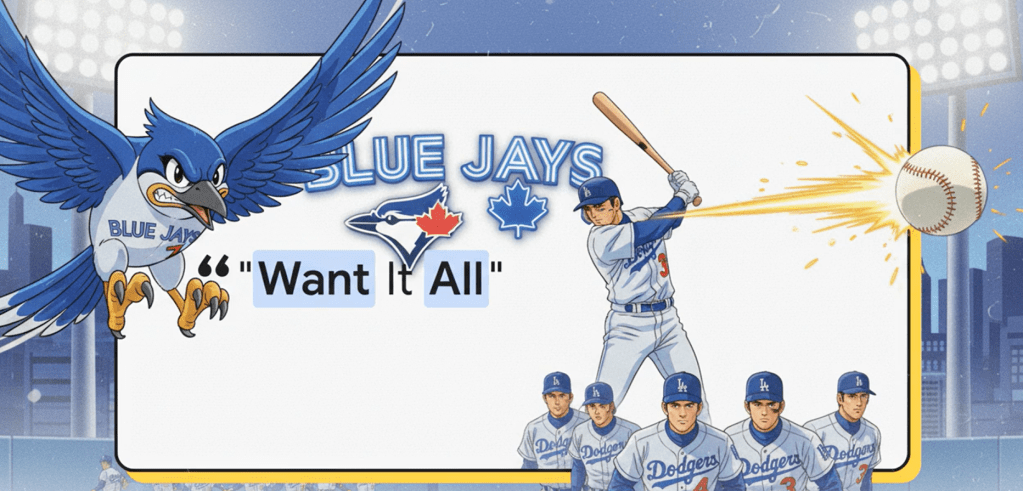
In the previous series, we analyzed how the defending champions—the Los Angeles Dodgers—could leverage their deep, well-rounded roster to chase a repeat.
This new two-part series shifts the focus to the challengers—the Toronto Blue Jays—examining how they can perform better in this year’s World Series and fight to reclaim the crown after a drought of more than 30 years.
The Blue Jays last won the World Series in 1993. They captured back-to-back titles in 1992 and 1993, beating the Atlanta Braves and the Philadelphia Phillies, both by 4–2. Those two years are also the only times in franchise history the Blue Jays reached the Fall Classic.
This year, Toronto finished 94–68, narrowly ahead of the Dodgers’ 93–69, so the Jays hold home-field advantage in Games 1, 2, 6, and 7. Still, compared with the Dodgers’ postseason pedigree in recent years, the Blue Jays—who finished last in the AL East just a year ago—enter as the “challengers.” They’ve improved significantly, but they’re facing a long-time, steady winner with loads of experience.
Before the final day of the regular season (Game 162), the Blue Jays and New York Yankees were tied at 93–68, making the last game a de facto playoff to decide the AL East title and the AL’s No. 1 seed. Although the Yankees beat the Orioles 3–2 in G162, the Blue Jays routed the Rays 13–4; with an 8–5 head-to-head edge over New York, Toronto claimed the 2025 AL East crown and the league’s top seed.
In the ALDS, the Jays’ bats erupted in a 3–1 win over the Wild Card Yankees. In the ALCS against the Seattle Mariners, they stumbled out of the gate with two home losses, but rebounded in Seattle with big wins in Games 3 and 4 to even the series. Although they dropped Game 5 after a game-tying solo shot by Cal Raleigh and a go-ahead grand slam by Eugenio Suárez, they returned home to take Games 6 and 7. In the decisive Game 7, veteran “leadoff warhead” George Springer crushed a go-ahead three-run homer in a key moment to lift the Jays to a 4–3 win over the Mariners and into the World Series to face the Dodgers for the 2025 championship.
“Want It All” was the Blue Jays’ rallying cry heading into October. Now the maple-leaf squad really is on the dream stage, staring down the postseason stalwart Dodgers. Chasing a title that has eluded them for 32 years, Toronto is trying to script the perfect 2025 comeback.
This series is split into two articles and seven sections:
- Overview of the starting rotation (regular season → postseason)
- Overview of the bullpen (regular season → postseason)
- Overview of the offense/lineup (regular season → postseason)
- Team defense and overall fielding (regular season → postseason)
- Projected 26-man World Series roster
- Possible World Series tactics and in-game management
- Summary and overall outlook
Part 1 covers Sections 1–3; Part 2 will cover Sections 4–7.
Now, let’s examine how the Blue Jays match up in this World Series, and how they might approach it:
(1) Starting rotation overview (regular season → postseason)
Overall, the Jays’ starters weren’t outstanding during the regular season: team ERA 4.34 (20th in MLB) and starters’ WAR just 8.5 (23rd). But once the postseason began, the rotation settled in: team ERA dropped to 3.33 (5th), and in seven postseason wins, starters were credited with five of them—showing stability and poise under pressure and becoming a key reason they reached the World Series.
Toronto used 15 starting pitchers this year; three made at least 30 starts—Kevin Gausman (32), Chris Bassitt (31), and José Berríos (30). That underscores a big rotation strength: excellent overall health and availability. In the World Series, however, only Gausman is slated to start; Berríos is out with right elbow inflammation, and Bassitt moves to the bullpen as a long man to add depth.
Beyond that main trio, frequent starters included Max Scherzer (17), Eric Lauer (15), Bowden Francis (14), and Shane Bieber (7). Scherzer and Bieber are in the postseason rotation; Lauer teams with Bassitt as a left-right long-relief pair; Francis was shut down late with shoulder impingement.
The Jays also turned to several young or spot starters: Easton Lucas (5), Trey Yesavage (3), José Ureña (2), Paxton Schultz (2), Spencer Turnbull (1), Braydon Fisher (1), Louis Varland (1), and Yariel Rodríguez (1). The most eye-catching is Trey Yesavage—the young righty showed mature stuff in October and has been tabbed to start World Series Game 1, likely facing Dodgers ace lefty Blake Snell. The “rising star vs. veteran” duel is one of the series’ headline matchups.
Current postseason rotation plan:
- No. 1 (scheduled WS G1): Trey Yesavage
- No. 2: Kevin Gausman (the No. 1 in earlier rounds, set for WS G2)
- No. 3: Shane Bieber
- No. 4: Max Scherzer
Toronto has also used reliever Louis Varland as an opener, a common modern tactic when a rotation spot is thin. In ALDS Game 4 vs. the Yankees, Varland opened and the bullpen followed in waves; the Jays won 5–2—showcasing the staff’s flexible in-game management.
Notably, all five pitchers who have started for the Jays this postseason are right-handed, with lefties almost exclusively in the bullpen. That profile could be a subtle edge versus the Dodgers: when hitters repeatedly face similar right-handed looks, their adjustment window can shrink. Still, if Toronto needs to revisit opener/quick-hook strategies mid-series, effectively deploying their lefties from the pen will be crucial to making those plans work.
Trey Yesavage—Toronto’s G1 starter—is arguably the club’s biggest surprise of the season. Just 22, he began the year in Low-A, having been selected 20th overall in last summer’s draft. He tore through the minors with strikeout stuff and mature command and debuted on September 15 (U.S. time).
In the regular season, Yesavage threw only 14 innings but struck out 16 with a 3.21 ERA. In the postseason, he’s shown even more power: three starts, 15 IP, 22 K, a 36.1% K rate, and a 4.20 ERA—still imposing. From last year’s draft stage to the World Series mound in one year: it’s one of the Jays’ most inspiring, emblematic stories of 2025.
Why start Yesavage in G1?
(1) Miss-bat ability as the main weapon.
His strikeout rate is elite. While command can still improve, in high-tension games his ability to induce whiffs can wreck hitters’ plans and control tempo, especially in key moments.
(2) Tactical surprise.
Most expected Kevin Gausman to maintain the G1 role after posting a 2.00 ERA in ALDS/ALCS. Precisely for that reason the Dodgers likely prepped heavily for him; by contrast, they have limited reps and scouting “feel” against Yesavage. The Jays may be trying to catch LA off guard in the opener.
There’s also a scheduling angle: Gausman pitched in relief in ALCS Game 7 (Taiwan time Oct 21). Pushing him to WS Game 2 gives him a fuller rest cycle—four days between outings—to be at his best.
In 2025, Gausman made 32 starts and logged 193 innings (6+ per start). His 10–11 record was more about low run support (4.33) than performance. K% 24.4%; BB% 6.5%; K/BB 3.78. In October: 2.00 ERA, .161 opponent AVG, and a 92.6% LOB%—big-time damage control—even if K/BB dipped to 1.33. He remains the rotation’s metronome.
Both Yesavage and Gausman lean on the splitter. This pitch is especially useful for right-handers versus lefty bats because of its late drop and deceptive entry. This year, Yesavage used it 26.4% and Gausman 37.5% of the time, pairing it with high fastballs for the classic “up fastball / down splitter” tunnel. Against LA’s lefty stars—Shohei Ohtani, Freddie Freeman, Max Muncy—expect that usage to tick up to disrupt vision and timing and to blunt pull-side loft.
Shane Bieber is slated for No. 3. The former Guardians ace and Cy Young winner was traded to Toronto to bolster the staff. In 7 regular-season starts (40.1 IP) he posted a 3.57 ERA with sharp command (K/BB 5.29, BB% 4.4%, LOB% 84.4%). The worry is a career-high HR/9 (1.79). In October: 3 GS, 12.1 IP, 4.38 ERA, K% 26.8%, BB% 5.4%, but a .302 opponent AVG—stuff is there; managing contact quality is key. Against LA’s selective, disciplined lineup, he must land the slider and knuckle curve down and sequence them cleanly with the heater; miss up and he’ll pay.
Max Scherzer (No. 4), 41, signed a 1-year, $15.5M deal. He left his first start injured but later found some stability: 17 GS, 5.19 ERA, 5+ IP/start, K/BB 3.57, with a high HR/9 (2.01). His October résumé (31 G, 3.75 ERA) and mentality still matter. In ALCS Game 4, with two outs and a man on in the fifth and Toronto up 5–1, manager John Schneider started up the mound; Scherzer loudly waved him off, then struck out the next hitter and roared off the field. He later said he was deep in sequencing and didn’t want a disruption. Even at 40+, the competitive fire is intact—and that edge is part of Toronto’s October identity.
(2) Bullpen overview (regular season → postseason)
The bullpen graded middle-back in the regular season: 3.98 ERA (16th) and 3.2 WAR (18th).
Strengths: opponents’ AVG .224 (4th), K% 25.3% (upper tier)—good at limiting hard contact and missing bats.
Weakness: BB% 10.3% (7th worst)—free passes create avoidable traffic, a dangerous flaw versus LA’s patient hitters.
In the postseason, performance has dipped: 5.52 ERA (10th) and 5.70 FIP, ahead of only the Reds (eliminated in the Wild Card). Volatility in relief is the roster’s biggest uncertainty. Starters need to go long to avoid middle-innings wars; in a pure bullpen duel, Toronto could be at a disadvantage.
Twelve relievers have appeared; four pitched in more than half of the 11 games: Louis Varland (9), Seranthony Domínguez (7), Mason Fluharty (7), Jeff Hoffman (6).
- Hoffman (closer): 1.23 ERA, the most stable finisher.
- Domínguez (setup): 4.05 ERA, typical 8th-inning role.
- Varland: 3.27 ERA, often used to douse fires—but all four of his earned runs came via homers.
- Fluharty (young LHP): 6.23 ERA; vital as a lefty given the RH-heavy rotation.
Varland’s susceptibility to HR is the key risk. His 2025 regular-season HR/9 (0.74 across MIN/TOR) was excellent, but October mistakes have been punished by power lineups. Against the Dodgers’ pop, commanding entry points and launch angles will be critical to avoid momentum-swinging shots.
Yariel Rodríguez transitioned from starter (2024: 4.47 ERA) to reliever in 2025 with clear gains: 66 G, 3.08 ERA, opponent AVG down to .194, and average FB up from 93.9 to 95.7 mph. But in this postseason he’s walked 4 in 2.2 IP with a 10.13 ERA, hurting trust in leverage. As a result, steadier arms (Domínguez/Varland/Hoffman) have absorbed the key innings.
Two regular-season cogs have wobbled: Brendon Little (79 G, 3.03 ERA → 12.00 ERA in October; walks/mistakes) and Braydon Fisher (51 G, 1.85 ERA → 7.36 ERA in October; strikeouts still there, but contact quality spiked). This forces cautious usage.
Because the four postseason starters are all righties, timing the lefties in the pen is extra important. Likely WS lefties: Little, Fluharty, Eric Lauer, Justin Bruihl. With LA’s lefty thump (Ohtani, Freeman, Muncy), choosing the moments carefully is crucial. Manager Dave Roberts often counters with a “zigzag lineup” (alternating handedness) and has switch/ambidextrous flexibility (e.g., Tommy Edman), pushing opponents into frequent pitching changes. Toronto must pivot cleanly between R/L looks.
Given the pen’s shakiness, the Jays have already used starters (even Gausman, and Bassitt as long relief) in October. Expect the WS roster to carry more multi-inning relievers to stabilize games if a starter exits early and to cover extras. That flexibility—especially Bassitt’s—could be pivotal.
(3) Offense and lineup overview (regular season → postseason)
Toronto’s offense is among MLB’s best. They scored 798 runs (4.93/game), 4th in MLB and 2nd in the AL behind the Yankees.
By advanced metrics, the hitters produced 32.6 WAR (also 2nd to the Yankees), reflecting both depth and impact.
Regular-season team slash line: .265/.333/.427—No. 1 in AVG and OBP. Slugging .427 ranked 7th; ISO .162 ranked 12th. Translation: a steady-pressure lineup built on OBP and contact rather than pure HR dependence, but with enough thump to flip innings.
They also led MLB with the lowest K% (17.3%) and the best BB/K (0.47)—superb plate discipline underpinning their on-base engine.
The drawback is baserunning: BsR –5.6 (25th), 77 SB (28th), Spd 4.0 (28th). They don’t pressure defenses with speed; they string hits. Against a deep staff like LA’s, if OBP sags, tempo can tilt away.
George Springer led the team with a 166 wRC+, enjoying a full-on renaissance at age 36 (.309/.399/.560). In October he’s at just .239, but slugging .609 with 4 HR and 11 RBI; his three-run blast off Eduardo Bazardo in ALCS G7 flipped the series.
The hottest postseason bat is Vladimir Guerrero Jr.: 6 HR, 12 RBI in 51 PA, slashing .442/.510/.930 (wRC+ 280) with only 3 K and 6 BB—power plus elite swing decisions. He was the ALCS MVP. He signed a 14-year, $500M mega-deal in April—the largest in club history—after agreeing to $28.5M to avoid arbitration (3rd-highest arb salary ever, after Juan Soto 2024 and Shohei Ohtani 2023). Regular season: wRC+ 137, 23 HR; October has made the contract look every bit like a franchise centerpiece bet.
Several role players have surged in October:
- Ernie Clement (3B): reg wRC+ 98 → 195 in postseason; .429 AVG and just 4.4% K, a true rally extender.
- Andrés Giménez (defense-first MI): reg wRC+ 70 → .263/.317/.447 in October with 2 clutch HR (ALCS G3 & G4), 6 RBI (2nd to Springer).
Addison Barger (25; 3B/OF) has impressed: reg wRC+ 107; postseason 149 (ALDS 109 → ALCS 166) with 2 HR and 4 RBI—youthful thump that lengthens the order.
Outfield anchors Nathan Lukes and Daulton Varsho have been solid: reg wRC+ 103 (Lukes) and 123 (Varsho). Postseason: Lukes 125, Varsho 121 overall but polarized—302 in the ALDS, just 15 in the ALCS. Regaining timing in the WS is a key variable.
Behind the plate, Alejandro Kirk reclaimed his bat: reg wRC+ 116 with a career-high 15 HR; postseason wRC+ 107 with 3 HR and 7 RBI—stabilizing the lower third and preserving lineup flexibility.
Defense-driven pieces Davis Schneider (reg 127; post 108), Isiah Kiner-Falefa (IKF) (reg 72; post 54), and Myles Straw (reg 91; post 54) provide positional versatility. They aren’t core bats, but they enable in-game switches and late-inning run prevention.
A major unknown for the WS roster is whether Bo Bichette returns. He posted wRC+ 134 and 3.8 WAR (4th on the team) in the regular season but missed the ALDS/ALCS with a right knee sprain. He’s reportedly progressing well, and manager John Schneider suggested he may return at 2B (to keep the red-hot Ernie Clement at 3B). The current 2B, IKF, has struggled at the plate (postseason wRC+ 54). Although Bichette has never played 2B in his 6,184 MLB regular-season innings, it’s still middle infield and slightly less demanding than SS; the transition could be manageable.
It’s risky under WS pressure—small misreads can be costly. But if Bichette adapts quickly and stays healthy while Clement keeps hitting, Toronto’s offensive ceiling rises without a major defensive tradeoff—a potential difference-maker.
Anthony Santander, signed as a free agent from the Orioles to boost middle-order power (2024: wRC+ 128, 44 HR), has been limited by injuries: 54 games, 6 HR, wRC+ 61. He struggled in October (wRC+ 29) and was removed from the ALCS roster with a back issue, likely missing the WS—a significant what-if. The five-year deal still projects value if he gets right over the winter.
Overall: The 2025 Jays feature balanced, deep offense with elite OBP, low K%, and enough pop to change games. They have multi-position depth for matchup tailoring. Against LA’s arms, if they maintain discipline and keep the line moving, they can go punch-for-punch.
(Next article preview)
That’s Part 1/2 of the Blue Jays’ World Series outlook—covering the rotation, bullpen, and bats. Part 2 will examine team defense, project the WS 26-man roster, and analyze likely tactics and adjustments, followed by a wrap-up.
Sources
Wikipedia
FanGraphs
MLB.com
CPBL official site
Baseball Savant
Sportsnet CA
Yahoo Sports (Taiwan)
Taiwan Baseball Wiki
NOWnews
 A Fan's MLB Insight
發表留言