The previous article (Part 1/2) analyzed the following
- Pre-game forecast
- Game highlights
- Performance of Dodgers’ starting pitcher Jack Flaherty
- Performance of Padres’ starting pitcher Dylan Cease
- Performance of both teams’ bullpens
This article (Part 2/2) will continue to describe:
- Batting performance of both teams
- Defensive performance of both teams
- Tactical details of both teams
- Areas both teams need to focus on for the remainder of the season
- Summary
Next, we will delve into these aspects and further analyze the highlights and crucial moments of the match.
⚾️ Batting Performance of Both Teams ⚾️
(Los Angeles Dodgers’ performance)
Here’s the Dodgers’ starting lineup for this game
Image source / MLB Official APP

Before this game, the Dodgers had a wRC+ (Weighted Runs Created Plus) of 129 in September, ranking second in the league, only behind the Seattle Mariners. During this period, the Dodgers’ team slugging percentage was a league-leading .478.
In September, most Dodgers players had a wRC+ above 100, with the exception of Gavin Lux, whose wRC+ was below 100 at 59. The rest of the hitters all exceeded 100. Shohei Ohtani stood out with a September wRC+ of 219, hitting 9 home runs, driving in 25 runs, and successfully stealing 12 bases, potentially challenging the single-season record of 55 home runs and 55 steals. Other players like Teoscar Hernandez, Max Muncy, Tommy Edman, and Mookie Betts also had September wRC+ values reaching or exceeding 130, respectively: Teoscar Hernandez (wRC+ 181), Max Muncy (wRC+ 143), Tommy Edman (wRC+ 132), and Mookie Betts (wRC+ 130).
In this game, the Dodgers started their offense in the bottom of the first inning. Ohtani drew a walk, advanced to second on a wild pitch, and with two outs and a runner on second, Teoscar Hernandez hit a fly ball single to center, scoring Ohtani and giving the Dodgers a 1:0 lead.
By the bottom of the fourth inning, although the first two Dodgers hitters were out, Tommy Edman capitalized on a high slider, hitting a fly ball single to right field. Then, Gavin Lux, facing a high fastball, hit a fly ball single to center, helping the Dodgers tie the game (from 2:1 to 2:2). In this inning, Padres’ starting pitcher Dylan Cease struggled with high pitches, allowing the Dodgers hitters to seize the opportunity for solid hits at crucial moments. With two outs and runners on first and second, Ohtani again capitalized on a high pitch in the strike zone from Cease, hitting a fly ball double to right field, helping the Dodgers take the lead.
By the bottom of the sixth inning, with the score at 3:3, Dodgers hitters Will Smith and Tommy Edman both drew walks. After one out, Andy Pages, replacing Miguel Rojas (who left due to left hip tightness), took his turn at bat. He capitalized on Cease’s high slider, hitting a fly ball to left-center, but it was ultimately caught by Padres’ center fielder Jackson Merrill, failing to score for the team.
However, Ohtani, at a crucial moment with a 2-ball 2-strike count, faced a high sinker from Cease, hitting a fly ball single to center, giving the Dodgers a 4:3 lead. Ohtani’s hit became the game-winning RBI, securing the Dodgers’ final victory.
In this game, the Dodgers totaled 8 hits, with leadoff hitter Ohtani responsible for 2 of them, contributing two RBIs. His two RBI hits both helped the team take the lead at those moments. Additionally, third hitter Freddie Freeman also had a 2-for-4 performance. However, it was regrettable that while the leadoff and third hitters both had multiple hits, the second hitter, Mookie Betts, had 4 at-bats with no hits.
It’s noteworthy that Betts’ four outs were all infield pop flies caught for outs, with three occurring with runners on base (mainly after Ohtani reached base 3 times in his 4 at-bats), marking a disappointing aspect of the Dodgers’ offense in this game.
Moreover, Dodgers’ fourth hitter Teoscar Hernandez also hit an RBI single in the bottom of an inning, helping the team score their first run of the game.
As for the Dodgers’ fifth to ninth hitters, seventh hitter Tommy Edman and eighth hitter Gavin Lux also recorded hits. Especially Gavin Lux, who, although he had the worst September hitting performance among the Dodgers’ nine starting hitters before the game, contributed two hits in this game, one of which occurred in the bottom of the fourth with runners on second and two outs and the team trailing by a run. Lux’s hit was crucial in helping the team tie the game.
In this game, the Dodgers had 12 at-bats with runners in scoring position, producing 4 hits and performing well. They capitalized several times on Cease’s high fastballs, aggressively attacking and producing multiple key hits. Ultimately, the Dodgers defeated the Padres 4:3, demonstrating key moment offensive firepower and seizing opportunities in the game.
As for Miguel Rojas, who left the game in the bottom of the fourth inning due to left hip tightness, he mentioned in a post-game interview that he felt discomfort in his left foot after catching a fly ball from Padres’ leadoff hitter Luis Arraez in the top of the third inning. Although he still felt pain in his left hip at the time of the interview, Rojas is very aware of his importance to the Dodgers’ postseason lineup. Therefore, he also expressed hope that he could return to the field within a few days after receiving an injection.
This season, Miguel Rojas has appeared in 103 games, producing a .283/.337/.410 batting line with a wRC+ of 111. Excluding the 2020 season shortened by the COVID-19 pandemic (which had only 60 regular-season games), this is his best full 162-game season batting performance. Additionally, Rojas has a batting average of .295 in scoring positions this season. Although his slugging ability in scoring positions isn’t as strong as usual, he has been able to seize opportunities at crucial moments, demonstrating his stability and contributions in scoring positions this season, becoming a player who can timely contribute.
(San Diego Padres’ performance)
Here’s the Padres’ starting lineup for this game
Image source / MLB Official APP
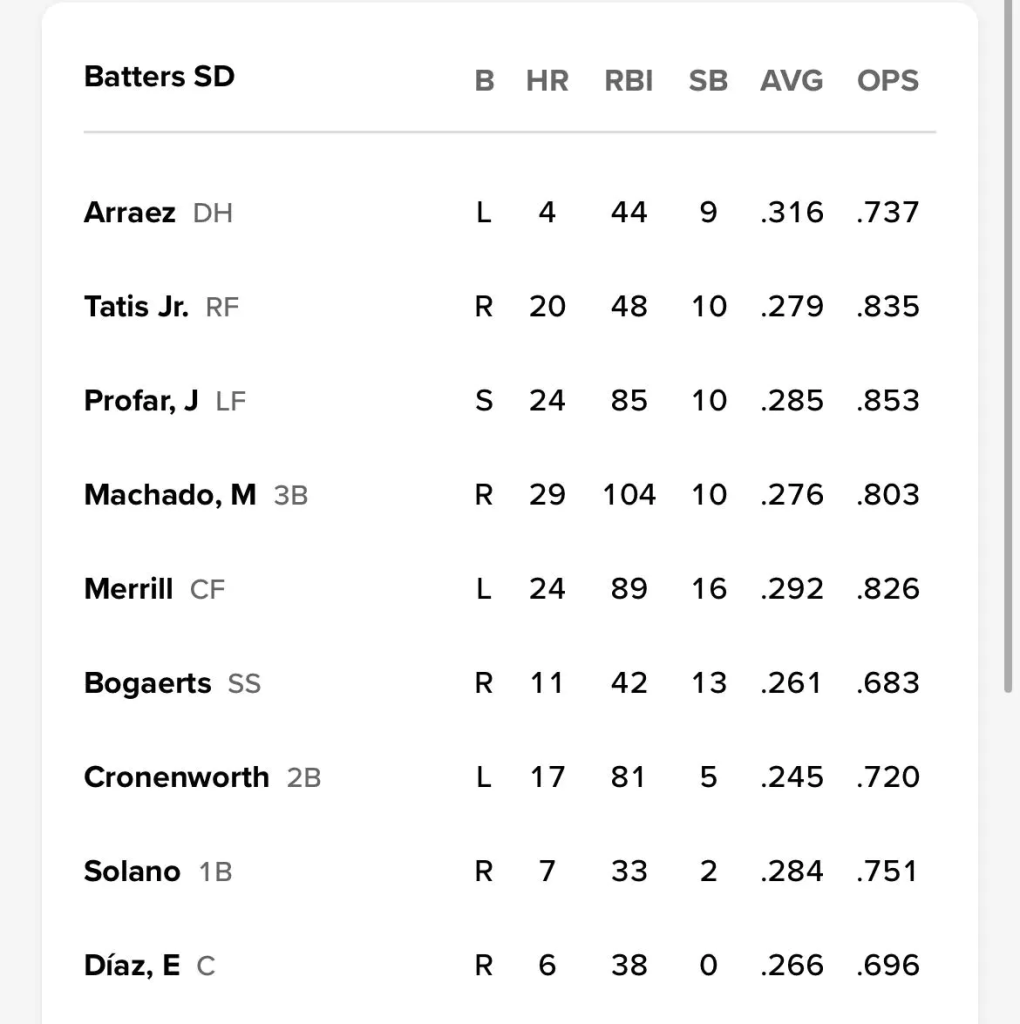
Before this game, the Padres had a September wRC+ of 115, ranking fifth in the league and third in the National League (behind only the Dodgers and Arizona Diamondbacks). During this period, the Padres’ team slugging percentage was .445, ranking third in the majors.
Before this battle, among the Padres’ starting nine, 4 players had a September wRC+ over 140, specifically Jurickson Profar (wRC+ 161), Jackson Merrill (wRC+ 160), Fernando Tatis Jr (wRC+ 146), and Manny Machado (wRC+ 145). Among these nine players, only Jake Cronenworth (wRC+ 91) and Donovan Solano (wRC+ 90) had a September wRC+ below 100, but their figures still reached at least 90. Overall, the Padres’ starting lineup players performed quite evenly in this game, showing stable offensive power.
In this game, the Padres launched an offensive in the top of the second inning. Manny Machado, after drawing a walk, reached first base with no outs, followed by super rookie Jackson Merrill hitting a double, putting the Padres in a great scoring position with runners on second and third. Then, the next batter, Xander Bogaerts, facing a low slider from Dodgers’ starting pitcher Jack Flaherty, hit a fly ball single to left field, helping the Padres tie the game.
However, the Padres were unable to further extend their lead in this inning. The next batter, Jake Cronenworth, although hitting a ground ball towards second base, successfully sent the third base runner Merrill home to score. But the following hitters, Donovan Solano and Elias Diaz, both struck out, leaving the Padres with a runner on second base and only managing to score two runs in the inning.
In this game, the Padres’ offensive momentum faltered after the third inning, producing only two hits, both hit by second hitter Fernando Tatis Jr. Notably, Tatis Jr, in the top of the fifth inning, facing a high fastball from Jack Flaherty, hit the ball with an initial speed of 114.4 mph, sending it 448 feet into left-center field for a solo home run, helping the Padres tie the game from 2:3 to 3:3.
However, this was the Padres’ last hit of the game. The Padres’ lineup was unable to produce any hits against the Dodgers’ relievers subsequently, unable to continue the offensive momentum. Although the Padres’ bullpen pitchers successfully suppressed the Dodgers’ scoring opportunities in the latter half of the game, the lack of performance from the lineup in the latter half ultimately led to the Padres’ 3:4 loss to the Dodgers.
In this game, the Padres’ batting performance with runners in scoring position was poor, producing only one hit in seven at
-bats. This sole hit was a fly ball single to left field by Xander Bogaerts in the top of the second inning, helping the team tie the game. Although the Padres produced several solid hits early in the game, taking advantage of Dodgers’ starting pitcher Jack Flaherty’s unstable pitching, Flaherty’s adaptability with runners on base and the Dodgers’ defensive performance prevented the Padres from effectively expanding the score at crucial moments.
Moreover, the Padres produced only 4 hits in the entire game, two of which came from second hitter Fernando Tatis Jr. He performed excellently in the game, contributing a long hit. Apart from Tatis Jr, Jackson Merrill and Xander Bogaerts each contributed a hit in the top of the second inning, which appeared consecutively, but the Padres were unable to further expand scoring opportunities.
⚾️ Defensive Performance of Both Teams ⚾️
In this game, both teams performed excellently in defense, with no errors occurring, and even showcasing several spectacular defensive plays, becoming one of the highlights of the game.
In the bottom of the first inning, with runners on first and second, batter Will Smith faced a high fastball from Dylan Cease, hitting a deep fly ball to right field. Fernando Tatis Jr made a spectacular catch near the wall, successfully preventing Will Smith’s potential extra-base hit. During this defensive play, Tatis Jr kept his eyes on the fly ball, accurately judged the landing point, and despite minimal movement during the catch, displayed perfect defensive execution.
In the top of the third inning, Padres’ hitter Luis Arraez hit a fly ball towards shortstop, with an initial speed of only 86.3 mph and a launch angle of just 13 degrees, making it quite challenging for Dodgers’ shortstop Miguel Rojas. Rojas, with his quick reaction and accurate judgment, successfully caught this potential hit.
In the bottom of the sixth inning, with runners on first and second and one out, Andy Pages faced Jeremiah Estrada’s inside slider, hitting a fly ball between left and center field. The ball was tricky, potentially becoming a hit or even an extra-base hit. Although the ball was closer to left fielder Jurickson Profar, it was ultimately center fielder Jackson Merrill who sprinted and made a diving catch, preventing Pages’ potential extra-base hit.
Overall, both teams exhibited outstanding defensive performance in this game, not only with no errors but also several spectacular defensive plays, making the game even more thrilling.
⚾️ Tactical Details of Both Teams ⚾️
This game lasted 2 hours and 47 minutes, ultimately resulting in a 4:3 victory for the Dodgers over the Padres. The teams combined for a total of 12 hits, making it a highly exciting and tightly contested match.
Both teams’ starting pitchers—the Padres’ Dylan Cease and the Dodgers’ Jack Flaherty—had good pre-game records but experienced significant turbulence during this game, providing both teams with multiple opportunities to break through the opposing pitcher and create big innings in the first half of the game.
By the top of the fifth inning, due to Dodgers’ shortstop Miguel Rojas leaving the game early in the bottom of the fourth inning due to hip tightness, the coaching staff decided to move center fielder Tommy Edman to shortstop and let Andy Pages take over Edman’s center field defense. Edman’s performance in the shortstop zone this season has been decent, with a Defensive Value (Def) of 1.2 over 91 innings, making this defensive shift reasonable. However, Pages’ Defensive Value in center field this season is below -2.0, indicating poor defensive efficiency. The Dodgers likely chose Pages, possibly due to his hitting performance in September, which was excellent with a wRC+ of 140 before this game, superior to other center field defensive players.
In the bottom of the sixth inning, when Padres pitcher Jeremiah Estrada had already secured two outs with runners on first and second, the Padres’ coaching staff decided to replace Estrada with left-handed pitcher Adrian Morejon to face Shohei Ohtani. This tactical decision was reasonable strategically, as Ohtani’s batting average against left-handed pitchers is relatively lower, and Morejon’s performance against left and right-handed hitters doesn’t differ significantly. However, this move ultimately failed, as Morejon allowed Ohtani to hit a fly ball single to center, which became the key hit that led to the Dodgers’ 4:3 victory.
In the top of the seventh inning, with the Dodgers leading 4:3, they decided to strengthen their defense by bringing in defensively strong Kevin Kiermaier to guard center field. Kiermaier’s defensive performance in center field this season has been excellent, so the Dodgers chose to bring him in at this critical moment to enhance the game’s defensive aspect in the latter half.
The Dodgers chose to let left-handed pitcher Alex Vesia continue pitching, likely because the next batter was left-handed hitter Jake Cronenworth, and Cronenworth’s batting performance against left-handed pitchers this season is significantly worse than against right-handed pitchers. However, Vesia ultimately walked Cronenworth, and this tactical decision did not achieve the expected result. Subsequently, the Dodgers brought in right-handed pitcher Evan Phillips to replace Vesia.
Evan Phillips had initially served as a closer early in the season, but after the Dodgers strengthened their bullpen with pitcher Michael Kopech, Kopech’s outstanding performance led the Dodgers to change their strategy, assigning Phillips to a setup role.
Phillips first struck out the next batter, Donovan Solano. Then, the Padres brought in left-handed hitter David Peralta to replace Elias Diaz, likely because Phillips is a right-handed pitcher. Although Elias Diaz’s batting average against right-handed pitchers (0.269) is higher than against left-handed pitchers (0.253), the coaching staff might have considered Diaz’s poor performance in this game (two at-bats with no hits and one strikeout), hence choosing to substitute Peralta.
Eventually, Evan Phillips induced David Peralta to hit a ground ball towards second base. Second baseman Gavin Lux passed to the covering shortstop, retiring the original runner on first, Jake Cronenworth. The Padres were unable to score in this inning, and the inning ended with the Dodgers still leading.
In the bottom of the seventh inning, the Padres let Kyle Higashioka replace the catcher, since Elias Diaz’s batting turn had been taken by David Peralta in the previous half inning. The Padres chose to let defensively superior and better pitch-calling Higashioka take over the catcher’s position. Simultaneously, the Padres also let left-handed pitcher Adrian Morejon face the next batter, Freddie Freeman. However, Morejon allowed Freeman to hit a double to second base, putting the Dodgers in a scoring position with no outs.
Faced with this crisis, the Padres decided to bring in right-handed pitcher Bryan Hoeing to replace Morejon. Although Hoeing is not a typical victory-setup pitcher for the Padres, the coaching staff considered his recent performance of not allowing any runs in his last five games, along with his suppression ability with runners in scoring position, and chose to have him pitch in this critical moment.
Hoeing first faced Teoscar Hernandez, who hit a solid ground ball towards shortstop, but thanks to shortstop Xander Bogaerts’ excellent defense, Hernandez was put out. Subsequently, Hoeing walked the next batter, Max Muncy, but eventually, he induced Will Smith to hit into a 6-4-3 double play, successfully resolving the Dodgers’ scoring threat with no outs and a runner on second, preventing further scoring.
Overall, both the Dodgers and Padres did not employ many special tactics in this game, mainly using multiple bullpen pitcher changes in the latter half of the game due to the close score. These pitching changes generally achieved good effects, maintaining a tense pace in the latter half of the game, with the score difference consistently kept to one run.
Since Shohei Ohtani hit the crucial RBI hit in the bottom of the sixth inning, both teams’ pitching staffs successfully suppressed the opposing lineup, with no further scoring displayed. This pitching arrangement led the game into a tense defensive situation, maintaining an intense confrontational atmosphere until the game ended.
⚾️ Areas Both Teams Need to Focus on for the Remainder of the Season ⚾️
After this game, the Dodgers and Padres have 4 more games left to play. The Dodgers currently lead the Padres by 3.0 games. If the Dodgers win tomorrow’s game at home against the Padres, they will clinch the NL West championship and directly enter the National League Division Series (NLDS).
Currently, both teams are statistically 100% certain to advance to the postseason, so the focus of the upcoming schedule will be on adjusting their condition and preparing for the postseason. Here’s an analysis of both teams’ strengths and the focus of their upcoming schedule adjustments:
(Adjustments needed in the Dodgers’ upcoming schedule)
Overall, the Dodgers’ hitting strength is undoubtedly one of their biggest advantages entering the postseason. This season, the Dodgers rank among the top in the league in various batting metrics, with an average of 5.12 runs per game, and possess strong power hitting, exerting significant pressure on opposing pitchers.
However, the Dodgers’ starting pitcher strength currently appears quite tight, mainly due to several key pitchers like Tyler Glasnow and Gavin Stone being absent due to injuries, confirmed not to participate in the postseason. This undoubtedly poses a challenge to the Dodgers’ pitching arrangement. Although they still have several outstanding starting pitchers, including Yoshinobu Yamamoto and Jack Flaherty, the Dodgers need to be wary of unstable performances from their starting pitchers, especially since their starting pitchers performed poorly in last year’s postseason, leading to their early exit despite a regular season record of 100 wins and 62 losses, swept 3-0 by the Arizona Diamondbacks.
Additionally
, the Dodgers’ bullpen performance in September is not ideal, with a 4.00 ERA, ranking 17th in the league, significantly worse compared to their overall season bullpen performance (season ERA 3.61, league 5th). The bullpen’s condition needs to stabilize quickly to avoid encountering more pressure in the postseason.
Although the Dodgers’ magic number to clinch the division is only 2, and they can secure the NL West championship by defeating the Padres in the next game, they need to prioritize determining the postseason starting pitcher order and allowing the bullpen to find a stable rhythm. This way, with strong lineup support, the pitching staff can more effectively help the team in the postseason, enhancing their competitiveness in deep playoff runs.
(Adjustments needed in the Padres’ upcoming schedule)
Overall, the Padres are a relatively well-rounded team, showing strength in both hitting and pitching. In advanced defensive metrics, although their overall Defensive Value (Def) is -5.6, ranking 20th in the league, they have only committed 71 errors all season, tied with the St. Louis Cardinals for fifth in the majors, indicating that despite poor advanced defensive metrics, they do not negatively impact the team with numerous errors.
In September, the Padres performed excellently, achieving a 14-6 record, a .700 winning percentage. Although their chances of competing for the NL West championship are not high, the Padres are highly likely to enter the postseason with a wild card and have a great opportunity to perform excellently in the wild card series. Especially since the Padres’ overall pitching performance in September has been outstanding, with a team ERA of only 2.42, ranking top five in the league for both starting and relieving pitchers, coupled with maintaining good offensive condition, laying a solid foundation for their postseason performance.
Although the Padres still have a chance to compete for the NL West championship, the likelihood is low. Therefore, in the next four games, especially after the game against the Dodgers (with Joe Musgrove as the starting pitcher), they will face a series against the Arizona Diamondbacks. The Diamondbacks are also a postseason hopeful team, and the Padres need to avoid being swept in this series, as the season series between the two teams is currently tied at five wins each. If the Padres are swept in this series, they will lose the home field advantage in the wild card series.
Therefore, the Padres must treat the next game against the Dodgers as a crucial battle. If they can defeat the Dodgers, they will ensure that in the worst case, they can still enjoy home field advantage in the wild card series. This will also allow them to more flexibly arrange their starting pitchers and lineup adjustments in the upcoming series against the Diamondbacks.
⚾️ Summary ⚾️
This game was extremely exciting, and although both teams’ starting pitchers (the Padres’ Dylan Cease and the Dodgers’ Jack Flaherty) encountered significant turbulence during the game, the Dodgers performed more effectively in key moments with runners in scoring position, slightly outperforming in offensive efficiency. Coupled with their bullpen successfully blocking the Padres’ offensive, the Dodgers ultimately secured the victory, further widening the game difference to 3.0 games from the start of the series.
In the next game, the starting pitchers for both teams will be the Padres’ Joe Musgrove (6 wins, 5 losses, 3.95 ERA) facing the Dodgers’ Walker Buehler (1 win, 6 losses, 5.63 ERA). From the starting pitcher matchup, the Padres seem to have a slight advantage in this aspect, with Musgrove’s stability relatively better. However, the Dodgers are more advantageous in terms of record. If they can win this game, they will secure their advancement to the postseason as NL West champions and ensure a top two seed, avoiding the need to play in the wild card series.
This concludes the analysis of this game~~
Sources /
MLB Official Website
Fangraphs
ET Today Sports Cloud
Baseball Reference
 A Fan's MLB Insight
發表留言