In the previous article, we analyzed Aaron Judge’s batting performance against various pitches, his plate discipline, and his batting style performance, as well as his hitting analysis under various conditions. This article will delve into his overall defensive performance, summarize his overall strengths and current weaknesses, and conclude with a summary.
The data is up to the end of the games on August 20, 2024, Taiwan time.
7️⃣ Detailed Analysis of Aaron Judge’s Defensive Performance
《Basic Fielding Percentage》
Data source: Fangraphs
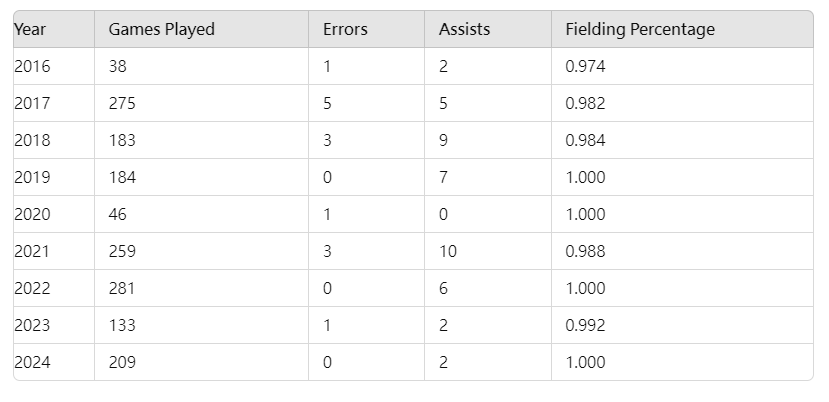
Overall, Aaron Judge’s defensive performance has been quite stable. In his career, covering 1608 outfield defense appearances, he has made only 13 errors, achieving a fielding percentage of 0.992. Additionally, he has made up to 44 long throw assists, demonstrating his exceptional throwing arm strength.
“Judge’s Yearly Defensive Innings by Position"
Data source: Fangraphs
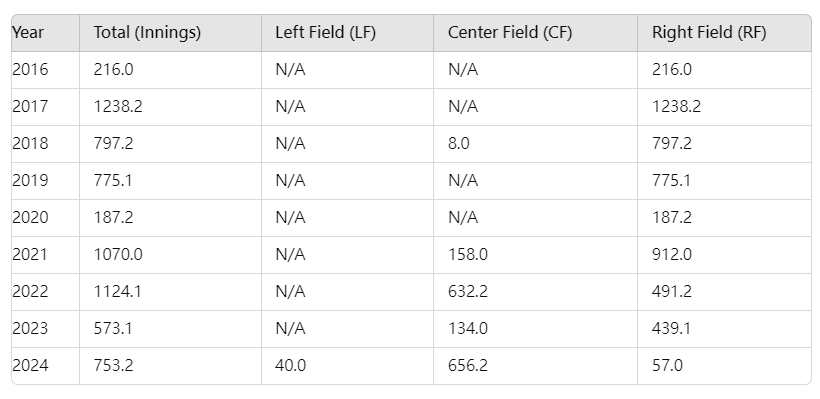
Aaron Judge has primarily manned right field throughout his 9-year MLB career. Particularly in the first five seasons (2016-2020), he played only 8 1/3 innings as a center fielder, with the rest of his time spent in right field. However, starting in 2022, after veteran teammate Brett Gardner gave up his team option contract with the Yankees (Gardner was the primary center fielder in the 2021 season), Judge began to have more opportunities to play as a center fielder.
In 2024, with former San Diego Padres slugger Juan Soto joining the Yankees and mainly playing right field, Judge naturally shifted to center field. This season, his defense in center field has been quite stable overall.
“Aaron Judge’s Yearly OAA Data"
OAA (Outs Above Average): Indicates how many more outs an outfielder makes compared to an average outfielder, not only considering the number of catches made and missed but also the difficulty of each catch. (Definition source: Major League Baseball Encyclopedia)
Data source: Fangraphs

This season marks the first in Aaron Judge’s career where he primarily played as a center fielder, having mainly served as a right fielder in his previous eight seasons. Overall, Judge’s defensive performance in right field, measured by Outs Above Average (OAA), is significantly better than in left field. His career OAA as a right fielder is 17, while as a center fielder, it is -2, showing a stark difference.
This discrepancy in performance is likely related to Judge’s familiarity and comfort with the defensive responsibilities of right field. Additionally, his large stature and less agile running speed may limit his range in center field.
“Aaron Judge’s Yearly UZR/150 Data"
Definition of UZR/150: Measures how many runs a player saves or costs his team over 150 games at a specific defensive position compared to the league average at that position. A higher value indicates more runs saved per game. (Definition source: Taiwan Baseball Wiki)
Data source: Fangraphs
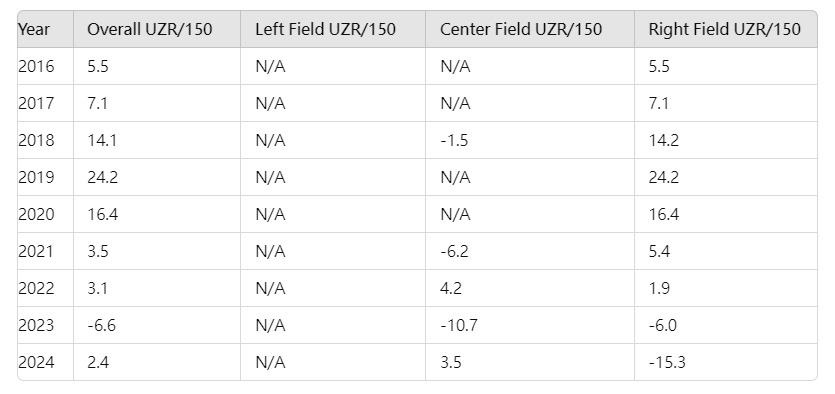
Overall, Aaron Judge is a player with a wide defensive range. In his 9-season career, only in 2023 did his UZR/150 fall below 0.0, and he even had consecutive seasons with UZR/150 values above 10.0. This year, Judge primarily defended center field, while when he played right field, the Yankees’ center field was usually manned by Trent Grisham, who has a considerable defensive range. As a result, many fly balls between center and right field are typically handled by Grisham, which is likely the main reason for Judge’s suboptimal UZR/150 performance in right field this season.
“Aaron Judge’s Yearly ARM Data"
ARM / Data measuring throwing arm strength
Data source: Fangraphs
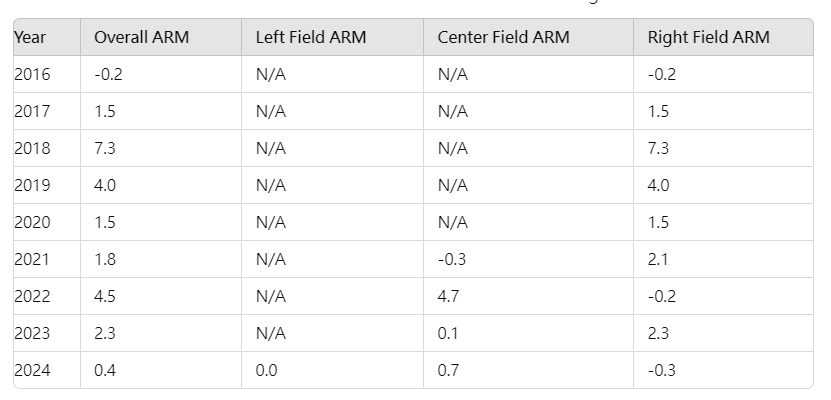
Overall, Aaron Judge is an outfielder with considerable arm strength. Over the past 9 seasons, Judge has had three seasons with an ARM rating of at least 4.0, including an exceptional performance in 2018 when he reached a total ARM of 7.3. However, this season, Judge’s performance was impacted by an abdominal injury and an incident in mid-June when he was hit by a pitch on his left hand, which also caused him to leave the game early. These events have resulted in lower ARM ratings this season compared to previous years.
Looking at the data, Aaron Judge’s ARM value this season has slightly decreased from previous years. This is not only due to some injuries he encountered at the start of the season but also because his primary defensive position has shifted from right field to center field. Additionally, Judge’s ARM value in right field this season is below zero (-0.3), likely because his frequency of handling the ball in right field was not as high as before. This is mainly because when Trent Grisham plays as a center fielder, Judge often shifts to right field, and Grisham, who has excellent defensive capabilities in center field, handles more plays, resulting in lower accumulated ARM data.
“Aaron Judge’s Yearly ErrR Data"
ErrR / Error Control Ability Data
Data source: Fangraphs

Aaron Judge is a player with remarkably stable defense, boasting a career ErrR (Error Run Saved) of 3.9, and has maintained positive values in this metric over the past 7 seasons (2018-2024). Notably, Judge has played 1589 1/3 innings in center field with an ErrR of 1.6, and 5107 1/3 innings in right field with an ErrR of 2.2.
This trend is linked to Judge’s increased opportunities in center field in recent years, where his defensive performance has been more stable compared to earlier seasons (particularly 2016-2017, when his ErrR was below 0). Notably, he has not made any errors this season. However, this may also be related to Judge’s relatively limited defensive range; he tends not to attempt overly ambitious defensive plays, thus reducing the occurrence of errors.
“Aaron Judge’s Yearly DRS Data"
DRS / Data used to calculate how many runs a player saves for his team per game (Source: Wikipedia)
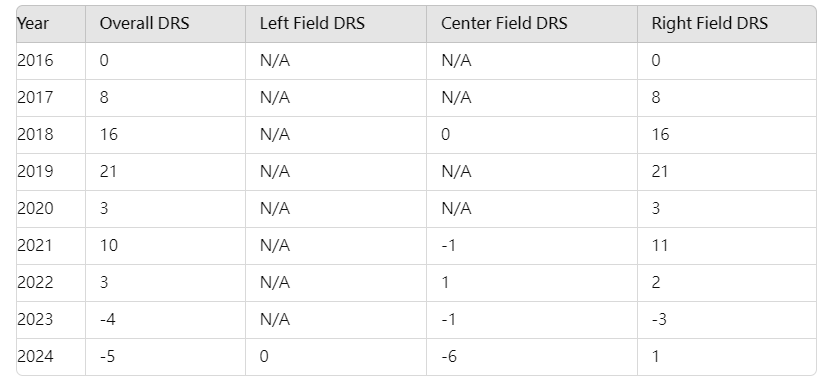
In the last two years, Aaron Judge’s Defensive Runs Saved (DRS) data has been negative, indicating a less than ideal overall performance. This is likely due to his limited defensive range in recent years, and even his arm strength for throwing has not been ideal this year. Although his overall defense remains stable, the scores he can save are quite limited.
In earlier seasons, Judge exhibited a broader defensive range and more attempts at outfield throws, which may have contributed to less stable defensive data, but also allowed him to save more potential lost runs.
Defensive Performance Summary
Overall, throughout his nine-year professional baseball career, Aaron Judge has been a player who can contribute significantly on defense. Whether in terms of throwing arm strength, defensive range, or stability, Judge’s contributions are substantial. However, in recent years, Judge has faced some injury issues, and this season his defensive area shifted from right to center field. Moreover, the Yankees have added many players with strong defensive skills this season, making Judge’s defensive strategy more conservative than in the past.
What areas can Aaron Judge still improve, and what advantages can he further utilize?
This year is the second year of Aaron Judge’s nine-year contract signed with the Yankees in 2023. This season, he has performed exceptionally well, with overall statistics comparable to 2022, the year he won the AL MVP. We will now organize the advantages Judge can further utilize, as well as some minor disadvantages that need adjustment.
Advantages to Leverage More
- Exceptional Hitting Power
Aaron Judge is not only known as a “slugger" for his power hitting, but he also stands out among all power hitters. His stature and explosive power, combined with a precise and clear pitch selection strategy, quick swing speed, and high home run output make his hitting power effective against fastballs and off-speed pitches alike. - Ability to Adjust Personal Weaknesses
Aaron Judge has managed to achieve outstanding results in MLB not only by maximizing his hitting power but also by timely adjustments to personal weaknesses. For example, he faced high strikeout rates in earlier seasons but has managed to maintain his power while decreasing his swing-and-miss rate over the years. - Few Weaknesses in Offensive Breakdown
This season, Aaron Judge maintains high OPS+ performance against both left and right pitchers, in various on-base situations, and across different counts, showcasing a well-rounded hitting direction. This variety makes it challenging for opposing pitchers to devise specific strategies against him. - Performance Beyond Hitting: Base Running and Defense
Aaron Judge not only excels at hitting but also shows good performance in base running (especially stealing bases) and outfield defense. He has a high success rate in stolen bases and commits few errors, showcasing strong arm strength and defensive range.
Disadvantages that Need Improvement
- Performance Against Off-Speed Pitches
Although Judge handles most types of pitches well, he struggles significantly against off-speed pitches, with a swing-and-miss rate nearing 50% this season. - Injury Prone in Recent Years
Over his nine-season career, Judge has had several seasons affected by injuries, limiting his playing time. This year, at age 32, he faces the potential impact of aging and past injuries on his performance.
Conclusion
Overall, Aaron Judge’s ability to perform, including hitting, defense, base running, and mental resilience, has been remarkably stable, bringing a significant sense of stability to the Yankees and establishing himself as a team leader.
The analysis of Aaron Judge concludes here, spanning three articles.
Sources: Fangraphs, Major League Baseball Encyclopedia, Wikipedia, Sports Vision.
 A Fan's MLB Insight
發表留言