Deadline Dates
2024/3/20 – 2024/7/28
During the 2023-2024 offseason, the powerhouse of the NL West, the Los Angeles Dodgers, made substantial reinforcements. In addition to signing the sensational two-way player Shohei Ohtani to a 10-year, $700 million contract, the Dodgers also adequately strengthened their roster in terms of starting pitchers and powerful hitters.
So far, the Dodgers have played 107 games, achieving a record of 63 wins and 44 losses, with a winning percentage of .589. They lead the San Diego Padres, who are in second place in their division, by 6.5 games and are ranked second in the National League overall, only behind the Philadelphia Phillies.
According to statistical analysis from the American baseball website Fangraphs, the Dodgers have a 99.0% chance of making the playoffs and an 88.4% chance of winning the NL West division. They also have a 79.5% chance of advancing directly to the divisional series, thus avoiding the wild card game. Furthermore, Fangraphs is very optimistic about the Dodgers’ chances of competing for the World Series title, estimating a 15.5% chance of winning, just behind the Phillies at 16.5%.
This three-part series will analyze how the Los Angeles Dodgers’ performance in pitching, hitting, and defense could impact their playoff performance this year, as well as the current strengths and weaknesses of their roster.
The first article (this one) will analyze the following:
(1) The overall strength of the Dodgers’ starting pitchers
(2) The overall strength of the Dodgers’ bullpen pitchers
The second article (next) will analyze the following:
(3) The overall offensive strength of the Dodgers
(4) The overall defensive strength of the Dodgers
The third article (after the next) will analyze the following:
(5) The managerial skills of Dodgers’ manager Dave Roberts
(6) A comprehensive review of the Dodgers’ performance in various aspects, summarizing their strengths and weaknesses
(7) Conclusion
(1) The overall strength of the Dodgers’ starting pitchers
Here are the statistical rankings for the Los Angeles Dodgers’ starting pitchers:
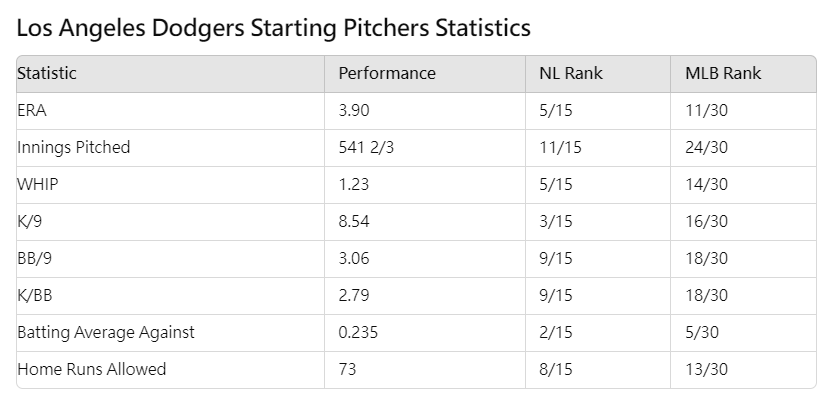
Metrics Explanation:
K/9 value: Average number of strikeouts per nine innings
BB/9 value: Average number of walks per nine innings
K/BB value: Strikeout-to-walk ratio, primarily estimates the pitcher’s overall control ability
Overall, the Dodgers’ starting pitchers have shown significant suppression power. In addition to a batting average against of only .235, ranking fifth in the league, their overall ERA of 3.90 is also above average. In terms of control data, the Dodgers’ starting pitchers are around the middle of the league, which is not bad. Additionally, many of their starting pitchers have significant strikeout abilities, hence their high K/9 value ranking third in the National League.
However, the Dodgers’ starting pitchers have pitched a total of 541 2/3 innings, ranking towards the lower end of the league, averaging just over five innings per game (5.06 innings when rounded to two decimal places). Moreover, in the “Quality Start Percentage" (QS%), the Dodgers are only at 35%, slightly below the National League average of 36%.
Additionally, the Dodgers’ starting pitchers average only 81 pitches per game, ranking 12th in the National League. In their 107 games, there have been 37 instances where the starting pitcher did not throw more than 80 pitches, accounting for over a third of this season’s games. Such data is quite disadvantageous for a team competing for the playoffs.
In fact, the Dodgers’ starting pitchers have faced significant injury issues this season. A total of 16 pitchers have started games, and the team has frequently used “openers" and bullpen games due to injuries. Due to the numerous injuries among starting pitchers, the bullpen has also been affected, necessitating the use of many pitchers originally intended for bullpen roles to start games.
Currently, Tyler Glasnow and Gavin Stone have made the most starts for the Dodgers, each appearing in 19 games, with overall ERA+ values between 110-120 (Glasnow ERA+ 113, Stone ERA+ 118), making them relatively stable starting pitchers for the Dodgers this season.
However, both pitchers currently face concerns. Tyler Glasnow has just returned from the injured list, and even though his overall stats are quite impressive, his career has been plagued by injuries that make it difficult for him to pitch a full season, including this year. Gavin Stone, in his first full season, has a high ERA of 6.27 in July (over 4 starts) and a high batting average against of .369 for the month, indicating a need for improvement.
James Paxton, who has the third-most starts for the Dodgers, was recently placed on waivers by the team and subsequently traded back to the Boston Red Sox, where he played last year. Paxton’s performance with the Dodgers this season has been subpar, averaging less than five innings per start. Despite receiving substantial run support from his teammates (8 wins, 2 losses), his overall pitching content has not been impressive for a team highly likely to compete in the playoffs.
Yoshinobu Yamamoto, who played for the Orix Buffaloes in Japan’s professional baseball last year, chose to challenge MLB through the posting system at the end of last season and successfully signed a massive 12-year, $325 million contract with the Dodgers. The contract includes a “no minor league assignment" clause, meaning Yamamoto can consistently pitch in the majors without worrying about being sent down. Yamamoto’s signing was mainly due to many Dodgers’ players being unavailable at the start of the season, prompting the team to sign the young (25 years old) and highly talented Yamamoto to bolster their starting rotation.
Yamamoto has made 14 starts this season, pitching 74 1/3 innings with an excellent ERA of 2.92 (ERA+ 135), demonstrating good control (K/BB ratio 4.94) and averaging over six innings per start, filling a gap in the Dodgers’ starting rotation.
Yamamoto is currently on the Dodgers’ 60-day injured list. However, Dodgers manager Dave Roberts recently revealed that Yamamoto will pitch in the bullpen this Friday (US date 8/2, Taiwan date 8/3) as part of his rehabilitation, and his return to the majors in the remaining month and a half of the season looks promising.
Recently, many of the Dodgers’ starting pitchers called up from the minors include River Ryan, Justin Wrobleski, and Landon Knack. The good news is that these starting pitchers have performed reasonably well overall, with the lowest ERA+ among them being Wrobleski’s 99, which is quite promising for a rookie.
In addition, veteran Dodgers pitcher Clayton Kershaw recently returned to the majors and pitched 4 1/3 innings with two earned runs against the Dodgers’ rivals, the San Francisco Giants, in his last outing. He threw 72 pitches, 47 of which were strikes, resulting in a strike percentage of 65.28% (47/72); his overall recovery appears to be going well.
Kershaw’s next start will be against the San Diego Padres on Taiwan date 8/1. His overall condition will have a significant impact on whether the Dodgers’ coaching staff includes him in the postseason roster. However, Kershaw’s advantage lies in his extensive experience, even though he was heavily defeated in the first game of last year’s NLDS against the Arizona Diamondbacks (0 1/3 inning, six earned runs). The coaching staff’s sense of stability with Kershaw still relies heavily on his previous seasons’ experience.
Moreover, since the Dodgers’ starting rotation is not fixed and the condition of their roster is unstable, the Dodgers are likely to strengthen their starting rotation before the upcoming 7/30 trade deadline. Especially considering that many of the Dodgers’ main starting pitchers are right-handed, they may specifically target left-handed pitchers for reinforcement.
(2) The overall strength of the Dodgers’ bullpen pitchers
Here are the statistical rankings for the Los Angeles Dodgers’ bullpen pitchers:
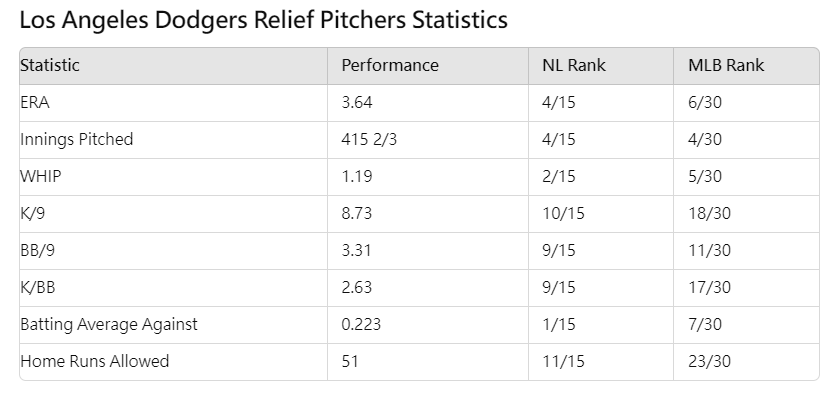
The Dodgers’ bullpen pitchers have performed quite well overall. Despite the starting pitchers’ limited endurance and heavier workload, the bullpen’s pitching results have been stable. Although their overall control data is not ideal compared to other National League teams, their ability to suppress opposing hitters and maintain the league’s lowest batting average against shows the significant contribution of the Dodgers’ bullpen.
However, the Dodgers’ bullpen stats in July have been less than ideal, ranking among the worst in the league. In the second game of the previous series against the Houston Astros, the Dodgers were leading 5:0 when starting pitcher Justin Wrobleski left the game after pitching 5 2/3 innings without an earned run; however, both runners he left on base eventually scored. The Dodgers ultimately lost to the Astros 6:7, with Astros hitter Alex Bregman hitting a walk-off home run in the bottom of the ninth inning (the pitcher who gave up the home run was Blake Treinen).
Therefore, whether the Dodgers’ bullpen can return to its excellent performance from the first two months of the season
(as of US date 5/31, the Dodgers’ bullpen ERA was 3.16, ranked third) is crucial for their overall strength in competing in the playoffs.
This season, the Dodgers’ closer role has been unstable, with nine pitchers recording at least one save. In recent years, the Dodgers’ primary closer, Evan Phillips, has been affected by injuries this season. After returning, his ERA rose from 0.66 to 4.18, particularly with a July ERA of 11.74 over 10 appearances, which is quite concerning.
The two most frequently appearing bullpen pitchers for the Dodgers this season are Alex Vesia (46 appearances) and Daniel Hudson (44 appearances). Currently, their ERA+ values are both over 200 (Vesia ERA+ 205, Hudson ERA+ 210), and they have also served as closers, each recording at least five saves. Notably, Alex Vesia is a left-handed pitcher, while Daniel Hudson is right-handed, which gives the Dodgers’ coaching staff more flexibility in managing their bullpen.
It’s worth mentioning that the Dodgers’ bullpen includes several talented left-handed pitchers. In addition to Alex Vesia, there are Anthony Banda (28 appearances, ERA+ 168, 30 1/3 innings) and Ryan Yarbrough, who primarily serves as a long reliever (32 appearances, ERA+ 106, 67 1/3 innings). This configuration allows the Dodgers’ coaching staff to be more flexible in arranging their bullpen options.
Notably, the Dodgers’ bullpen pitchers are generally older. Among the five most frequently appearing bullpen pitchers this season, three are over 30 years old (two of whom are over 35), and the youngest, Alex Vesia, is 28. While this might lead to a decline in physical endurance compared to the past, these pitchers’ extensive experience could allow them to perform more stably in critical games later on.
However, in July, many of the Dodgers’ main bullpen pitchers experienced a slump. Therefore, the Dodgers are likely to reinforce their bullpen before the 7/30 trade deadline.
This article (Part 1/3) will conclude here. The next article (Part 2/3) will explore the Dodgers’ overall offensive and defensive performance outlook.
Sources:
MLB Trade Rumors
MLB Official Website
Baseball Reference
Fangraphs
Yahoo Sports
ptt baseball
 A Fan's MLB Insight
發表留言