Ps. The data cut-off for this article is different from Part 1/2, so there may be a slight discrepancy in the OPS+ part, please excuse this.
In the previous article (Part 1/2), we introduced Yoshinobu Yamamoto’s Major League start-by-start performance and briefly analyzed his overall pitching style, detailed his pitch types, overall control, and his coordination with the team’s catchers.
In this article (Part 2/2), we will analyze Yamamoto’s overall interaction with opposing batters, his performance in various situations, and summarize his overall pitching strengths and areas that need improvement.
⚾️ Detailed Analysis of Yoshinobu Yamamoto’s Interaction with Opposing Batters ⚾️
Overall, Yoshinobu Yamamoto is quite adept at generating ground balls. This season, a high 48.2% of the hits he has given up have been ground balls, which is over 6.0% higher than the MLB average. His “ground ball to fly ball ratio (GB/FB)" is 0.94, significantly higher than this year’s MLB average of 0.74. Additionally, Yamamoto has generated fly balls at 26.6% and pop-ups at 20.1%.
Yamamoto’s ability to generate a large number of ground balls is mainly due to his primary “pitch types paired with fastballs" (such as splitters and curveballs), which have a significant downward trajectory, causing many of his pitches to be placed lower in the strike zone, making it easier for hitters to ground the ball. Another factor that significantly aids his ability to suppress opposing home runs is the overall nature of the contact generated by his pitches.
Typically, “ground ball pitchers" rely heavily on their infield defense, especially the defensive abilities of the middle infielders (second baseman and shortstop). This season, the Dodgers’ infield defense has been quite stable; aside from high defensive values in the second base, first base, and third base areas above the league average, errors have been rare, positively impacting pitchers like Yamamoto who generate many ground balls.
Ps. Def definition / Defensive runs saved above league average by a fielder
Notably, this season, Yamamoto’s “ground out to fly out ratio (GO/FO)" against right-handed batters is 1.56, significantly higher than against left-handers at 1.00. This discrepancy is mainly due to his higher use of breaking pitches (30.8%) against right-handers compared to left-handers (20.8%). This is because Yamamoto’s breaking pitches, primarily sliders and curveballs, have a pronounced drop and spin that make it difficult for hitters to drive the ball far.
However, Yamamoto’s overall “percentage of hard-hit balls (HardH%)" this season is 43.7%, higher than the league average of 39.3%, mainly because he gives up a slightly higher proportion of fly balls compared to the MLB average (26.6% for Yamamoto vs. 23.7% MLB average). Generally, fly balls are more solidly hit, which is one of the main reasons why Yamamoto’s HardH% is higher.
Ps. HardH% is defined as the percentage of batted balls with an exit velocity of 95 mph or higher.
⚾️ Detailed Analysis of Yoshinobu Yamamoto in Various Situations ⚾️
Ps. Below OPS+ is the comparative data for the league average under these conditions
(Against left and right batters)
As a right-handed pitcher, unlike most right-handers, Yoshinobu Yamamoto has less suppression against right-handed batters compared to left-handers.
Below are Yoshinobu Yamamoto’s 2024 data against left and right batters.
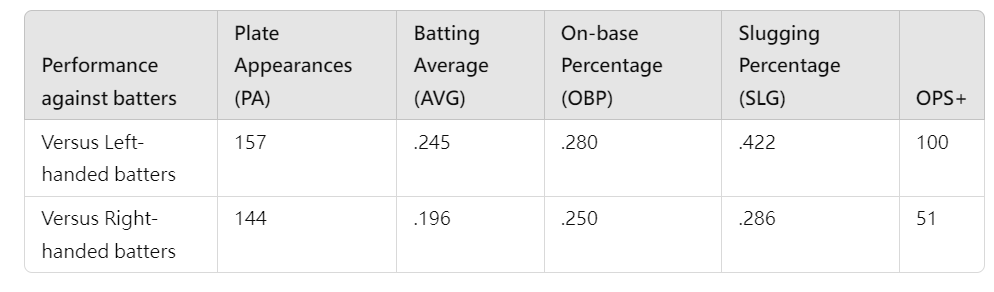
This season, Yuki Matsui has shown excellent control when facing left-handed hitters, with an overall batting average against him below .200 and effective suppression of extra-base hits. However, his performance against right-handed hitters, while not poor compared to the league, isn’t as dominant as against left-handers.
(Based on various situations on base)
Below is the data for Yuki Matsui in 2024 for different situations on base against batters.
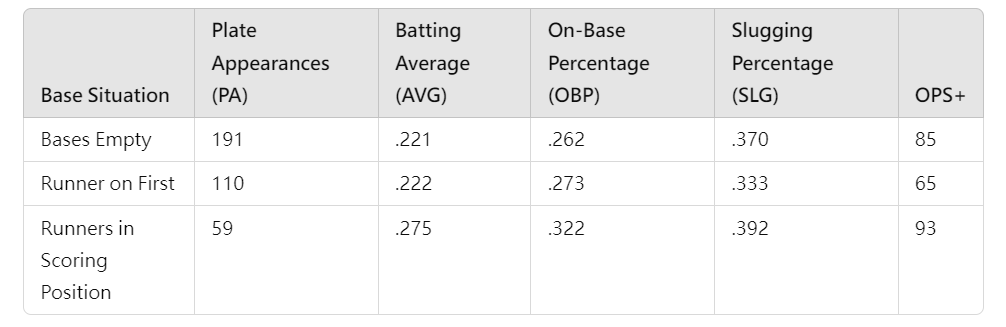
Overall, Yuki Matsui demonstrates significant control when the bases are empty, with an OBP of 0.262 which is quite low, and an impressive batting average allowed of 0.221. However, when runners are in scoring position, his batting average against rises to 0.275, and his K/BB ratio (3.20) is also less favorable compared to when the bases are empty (4.80).
(Count situations)
Below are the data for Yuki Matsui in 2024 under various count situations when he is ahead, behind, or even with batters.
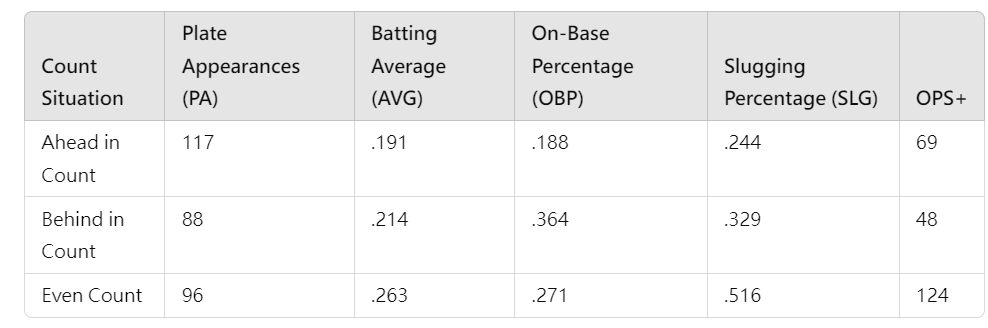
This season, Yuki Matsui’s significant disadvantage in counts is when the count is even with the batter. When Matsui faces batters with an even count, his batting average against rises to .263, making him particularly susceptible to extra-base hits. Notably, of the six home runs Matsui has allowed this season, five occurred in the first at-bat of an inning.
Although Matsui tends to be vulnerable when the count is even, he effectively suppresses the opposition’s offense when he is ahead or behind in the count, which is a key factor in the overall stability of his pitching performances.
Ps.
- Ahead in the count / More strikes than balls in all situations.
- Behind in the count / More balls than strikes, except in full count (2-2) situations.
- Even count / Strikes equal balls, including all full count (2-2) situations.
(The performance in different innings when facing batters)
The following are Yuki Matsui’s performances in different innings when facing batters.
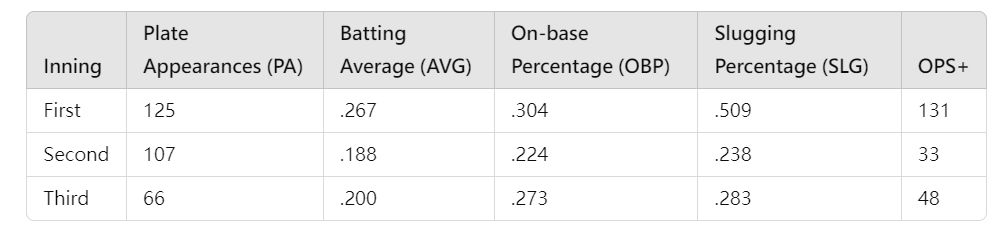
This season, Yusei Yamamoto has shown a significant weakness when facing hitters in the first round, with an opposing OPS+ of 131, indicating not only a higher-than-average batting average against him but also significant susceptibility to extra-base hits. However, after the first round, Yamamoto’s ability to suppress hitters significantly improves; during the second time through the order, his overall OPS drops below 0.5, demonstrating effective control over opposing batters.
This pattern is also reflected in his ERA across different innings. Yamamoto’s ERA for the first three innings is a high 4.85, yet from the fourth to the sixth inning, his ERA drops to an impressive 0.57, and after the seventh inning, it adjusts to 2.70. This suggests that Yamamoto’s performance improves as the game progresses, resembling a player who ‘eats the sugarcane from the end.’
(Performance by Home and Away)
Here is Yusei Yamamoto’s performance split between home and away games:

Yusei Yamamoto has shown impressive performance in away games this season, despite it being his first year in the Major Leagues. His ability to suppress opponents on the road has been notably better than at home.
While Yamamoto’s overall statistics for away games may not seem ideal, this is largely due to his first game at Gocheok Dome in Seoul against the San Diego Padres, where he surrendered five runs in just one inning. Excluding this game, his ERA at Dodger Stadium is only 2.58, and his control (K/BB of 8.20) has been excellent.
Yamamoto’s Strengths and Areas for Improvement
Strengths:
- Stability Under Pressure: In his first MLB season, Yamamoto has managed excellent stats even after being heavily targeted in his debut. His ability to quickly stabilize performance after initial setbacks demonstrates strong mental resilience.
- Strong Control: Yamamoto has always been known for his precision and strikeout abilities, dating back to his days in Japanese professional baseball. His control has remained strong in the MLB, making it difficult for hitters to get on base against him.
- Suppression of Home Runs: His ability to limit home runs has been crucial to his success. This season, he has allowed only six home runs in 74 2/3 innings, a home run rate significantly below the MLB average.
- Diverse and Effective Pitch Arsenal: Yamamoto utilizes a rich variety of pitches, effectively employing fastballs, offspeed pitches, and breaking balls, which makes it challenging for hitters to adjust to his and his catcher’s strategic pitching.
Areas for Improvement:
- Struggles in Early Innings: Yamamoto tends to be more vulnerable in the early innings, particularly the first, where his OPS against hitters is notably high (OPS+ 149) and his ERA in the first inning stands at 5.14.
- Performance in Even Counts: He tends to struggle when the count is even, showing a stark contrast to his effectiveness when ahead or behind in the count.
Conclusion:
Overall, Yamamoto’s abilities are robust, covering major aspects like control, quality of pitches, and diversity in his pitch types, leaving few apparent weaknesses.
Yamamoto is currently recovering from an injury. Although his recovery is progressing well according to the coaching staff, he is not expected to return immediately but should be able to pitch later in the season. If his recovery is swift and successful, it could significantly enhance his performance and benefit the team’s pitching strength.
This series will pause here, with updates to follow on his progress and performance.
 A Fan's MLB Insight
發表留言