On November 5, 2023, the Japanese professional baseball season concluded, and Yoshinobu Yamamoto, the ace pitcher for the Orix Buffaloes, announced his decision to challenge Major League Baseball (MLB) through the posting system.
On December 22 of the same year, Yamamoto smoothly signed a 12-year contract worth $325 million USD (approximately NT$10.958 billion, or an annual salary of $2,708,333 USD) with the Los Angeles Dodgers of the National League West. Additionally, the Dodgers had to pay a posting fee of $50.625 million to the Orix Buffaloes.
After joining MLB, Yamamoto showed commendable performance. In 14 starts, he pitched 74 and 1/3 innings, posting an ERA of 2.92, along with 84 strikeouts and 17 walks. Despite a rough MLB debut against the San Diego Padres, where he allowed five runs in the first inning and was pulled from the game, Yamamoto’s performance stabilized significantly thereafter, making him currently the second-highest pitcher in WAR (Wins Above Replacement) for the Dodgers (2.1, with Tyler Glasnow being the first).
Unfortunately, on his last start on June 15 (Taiwanese date), facing the Kansas City Royals, Yamamoto was pulled early after pitching only 2 and 1/3 innings. After the game, Dodgers manager Dave Roberts stated, “Yoshinobu Yamamoto has a strained right rotator cuff and will need some time to rest, but he will not be out for the season." Also, Yamamoto had felt some discomfort in his triceps a few days before the game, prompting the Dodgers to delay his start (which was supposed to be after the match against the New York Yankees). He is currently on a 15-day injured list.
This article will analyze Yamamoto’s MLB season condition. It is divided into 8 sections:
Game-by-game MLB performance of Yoshinobu Yamamoto.
General analysis of Yamamoto’s pitching style and overall data.
Detailed analysis of Yamamoto’s different pitch types.
Analysis of Yamamoto’s control and details with his catcher.
Detailed analysis of Yamamoto’s interaction with opposing batters.
Detailed analysis under various situations.
Summary of Yamamoto’s overall advantages and areas that need improvement.
Conclusion.
This article (Part 1/2) will analyze sections 1-4. The next article (Part 2/2) will cover sections 5-8.
⚾️ Yoshinobu Yamamoto’s Game-by-Game Performance in MLB ⚾️
Ps. All dates are in US time.
(Spring Training Performance)
Yoshinobu Yamamoto made his debut in the MLB system on February 28, 2024, against the 2023 World Series champions, the Texas Rangers. He pitched 2 and 1/3 innings, allowed one hit, and struck out three, showcasing impressive pitching skills.
Following this, Yamamoto gradually increased his innings pitched. On March 6, he faced the Chicago White Sox, and his next game was on March 13 against the Seattle Mariners. In these two games, Yamamoto continued to demonstrate strong strikeout abilities but also gave up a significant number of hits, totaling 7 and 2/3 innings with nine runs allowed, all earned.
Yamamoto started three games in spring training, pitching a total of 9 and 2/3 innings with a high ERA of 8.38, which led many fans to question whether the Dodgers’ decision to sign him to a 12-year, substantial contract was justified.
(Performance in March 2024 – 2 Starts)
The 2024 MLB season opened at Gocheok Dome in Seoul, South Korea, with the Los Angeles Dodgers facing the San Diego Padres in two games, each team hosting one game.
Many fans were eager to see a matchup between Yamamoto and Yu Darvish, who is also from Japan. Both pitchers, who challenged MLB at a young age, represent different eras of Japan’s prominent pitchers. Unfortunately, the fans’ hopes did not materialize; Yu Darvish started the first game against the Dodgers’ Tyler Glasnow, while Yamamoto started the second game against Joe Musgrove.
Yamamoto’s MLB regular-season debut was rough, lasting only 1 and 1/3 innings while allowing four hits and five runs, all earned. Although he struck out two, his overall control was suboptimal (53.49% strike rate). During this game, when facing Padres batter Luis Campusano with two outs and a runner on second (Padres leading 2-0), Campusano hit a grounder towards third base, but teammate Max Muncy made an unrecorded defensive error (recorded as a hit), which was a key factor in the significant runs allowed.
Ultimately, Yamamoto took the loss in this game, and his performance led to further doubts among fans about the justification of his contract with the Dodgers.
However, in his second start on March 30 at home against the St. Louis Cardinals, Yamamoto significantly displayed his pitching skills, throwing 5 and 1/3 innings, allowing only two hits, striking out five, and issuing no walks. By the end of the fifth inning, the game was scoreless (0-0), but the Dodgers took a 2-0 lead thanks to hits by Freddie Freeman and Will Smith, driving in Mookie Betts and Shohei Ohtani, who had reached base on walks. Unfortunately for Yamamoto, he did not qualify for the win as the Cardinals tied the game in the top of the seventh.
In March, Yamamoto started two games, pitching a total of 6 and 1/3 innings with an ERA of 7.50, which does not reflect well on paper. However, his strong performance in the second game raised fans’ expectations for his future development.
(Performance in April 2024 – 4 Starts)
Yamamoto’s first start in April was against the Chicago Cubs at Wrigley Field, marking his first away game in MLB.
In this game, Yamamoto faced a bases-loaded, no-outs situation in the bottom of the first, allowing two hits and a walk. However, he managed to strike out Christopher Morel, Dansby Swanson, and Michael Busch consecutively, leaving the bases loaded.
In the subsequent innings of this game, apart from another bases-loaded situation in the second inning which he overcame, he retired the side in order from the third to the fifth inning, pitching five scoreless innings and earning his first win of the season (also his first MLB career win).
His next game was on April 12, again against the San Diego Padres. Although Yamamoto pitched a full five innings, he allowed two home runs (hit by Manny Machado and South Korea’s Ha-Seong Kim), resulting in three earned runs, along with six strikeouts and one walk, and he did not factor in the decision. The Padres won the game in extra innings, 8-7.
On April 19, Yamamoto faced the New York Mets, pitching 6 and 1/3 innings, allowing seven hits, four runs (three earned), and striking out nine. Mets’ DJ Stewart hit a home run off him. This game also set new personal MLB highs for Yamamoto in pitches thrown (99), strikeouts (9), and innings pitched (6 and 1/
3).
On April 25, facing the Washington Nationals at Nationals Park, Yamamoto engaged in an exciting pitchers’ duel with the Nationals’ strong lefty, MacKenzie Gore. In this game, Yamamoto pitched six scoreless innings, allowed only four hits, and struck out seven, earning his second MLB win.
In April, Yamamoto made four starts, with a record of 2 wins and no losses and a monthly ERA of 2.45. He pitched a total of 22 innings, allowed 18 hits, seven runs (six earned), and struck out 30, giving him a K/BB ratio of 6.00. His cumulative ERA decreased from 7.50 after the games on March 31 to 3.54.
(Performance in May 2024 – 5 Starts)
Yamamoto started his first game in May against last season’s National League champions, the Arizona Diamondbacks, whose starting pitcher was last season’s champion team member from the Rangers, Jordan Montgomery (who signed a one-year contract with the Diamondbacks earlier this year).
Yamamoto outperformed Montgomery (3 and 1/3 innings, six earned runs) by pitching 6 and 1/3 scoreless innings, allowing five hits, striking out five, and walking two. The Dodgers defeated the Diamondbacks 8-0, and Yamamoto earned his third MLB win.
On May 7, the Dodgers hosted the Miami Marlins, and Yamamoto started again. Although he allowed a solo home run to Jazz Chisholm Jr. in the first inning, the Dodgers took a 4-1 lead in the bottom of the inning thanks to Max Muncy’s grand slam.
Yamamoto’s performance in this game was outstanding, pitching eight innings—the longest outing of his career—using only 97 pitches. He allowed five hits and two runs (both earned, home runs by Jazz Chisholm and Bryan De La Cruz), and the Dodgers won 8-2. Yamamoto earned his fourth win of the season in this game.
On May 13, the Dodgers faced their “arch-rival," the San Francisco Giants, marking Yamamoto’s first encounter with the Giants. The Giants’ starting pitcher was Jordan Hicks, who signed a four-year contract with the Giants this year to bolster their starting rotation.
Yamamoto pitched 5 and 2/3 innings, allowed five hits, four runs (all earned), and struck out six with two walks. He was taken deep by Giants batter Luis Matos for a three-run homer in the second inning and allowed a run-scoring single by Heliot Ramos with two outs and runners on first and second in the sixth, leaving the game as the potential losing pitcher.
However, in the top of the seventh, the Dodgers tied the game with a solo home run by Enrique Hernandez, helping Yamamoto avoid the loss. The Dodgers won the game in extra innings (10th inning) with a timely double by Will Smith, defeating the Giants 6-4.
On May 20, the Dodgers hosted the Diamondbacks at home, marking Yamamoto’s second career start against this division rival. In the top of the third, the Diamondbacks took the lead with a hit by former Dodger Joc Pederson with runners in scoring position, but the Dodgers responded with a six-run bottom of the third. Yamamoto pitched 6 and 1/3 innings, allowing two runs (both earned), striking out eight, and walking one, securing his fifth win of the season.
On May 26, the Dodgers faced the Cincinnati Reds, marking Yamamoto’s first career start against the Reds. The Reds scored four runs in the bottom of the third inning thanks to consecutive hits with two outs, and their second and third pitchers, Nick Martinez and Carson Spiers, effectively shut down the Dodgers’ lineup (the Reds’ listed starter for the game was Brent Suter, primarily a reliever, in a “bullpen game" strategy).
Yamamoto pitched a total of six innings, allowed six hits, four runs (all earned), struck out eight, and walked two, taking his second loss of the season. Despite a solid performance in all innings except the third, his team’s lineup was nearly shut down by the opposing pitchers, leading to his first loss in nine starts.
In May, Yamamoto made five starts, pitching a total of 31 innings, with a monthly ERA of 3.48, a record of 3 wins and 1 loss, and 12 earned runs. Additionally, he struck out 32 batters and walked seven (K/BB ratio of 4.57), slightly decreasing his cumulative ERA from 3.54 to 3.48.
(Performance in June 2024 – 3 Starts)
On June 1, Yamamoto pitched at home against the division rival Colorado Rockies. Although he allowed a run in the top of the second inning on a sacrifice fly by Brenton Doyle with one out and a runner on third
, the Dodgers immediately responded with runs in the bottom of the second and added one run in both the fourth and fifth innings. Yamamoto pitched well in the subsequent innings, totaling six innings, allowing seven hits, one run (earned), striking out seven, and walking one. He earned his sixth win of the season in this game.
On June 7, the Dodgers traveled to the Bronx to face the New York Yankees, the team with the best record in the league at that time. During the 2023-2024 offseason, both the Yankees and Dodgers made significant acquisitions, making them typical “powerhouse" teams in MLB with strong financial backing, leading many fans to describe this series as a “preview of the 2024 World Series."
Yamamoto pitched excellently in this game, lasting seven innings and allowing only two hits, along with seven strikeouts and two walks. The Yankees’ pitchers also performed exceptionally well, preventing any runs in the early part of the game. Thus, despite his strong performance, Yamamoto did not secure his seventh win of the season. Notably, he threw a career-high 106 pitches in this game.
The game remained scoreless (0-0) after nine regular innings, with the Dodgers eventually defeating the Yankees 2-1 in the 11th inning thanks to a double by Teoscar Hernandez (the Yankees scored on a bases-loaded single by Aaron Judge in the bottom of the 11th).
A few days after facing the Yankees, Yamamoto experienced discomfort in his right triceps, prompting Dodgers manager Dave Roberts to delay his next start to adjust his condition.
However, on June 15, during a home game against the Kansas City Royals, Yamamoto had to leave the game early due to tightness in his right triceps. He pitched two innings, allowed one hit, struck out one, and walked one, throwing only 14 strikes out of 28 pitches (50.00% strike rate), which likely indicated control issues caused by his injury.
After the game, Dodgers manager Dave Roberts stated that Yamamoto would take some time off to rest and adjust, aiming for a return in early July. A return before the All-Star break (mid-season) seems unlikely, but he will not be out for the season.
Furthermore, Roberts mentioned, “Fortunately, the season has not reached a critical point yet, so his health is most important. We’ve proactively placed him on the injured list to allow him time to adjust." Additionally, Roberts stated that they would handle the situation cautiously and restart only after resolving the issue.
Additionally, it was noted that Yamamoto threw more sliders during this period. Since sliders require more wrist action and thus greater arm strain, this could explain the increased stress on his arm. In response to concerns about the slider, Coach Dave Roberts acknowledged that while Yamamoto did use the slider during the game against the Yankees, he is entitled to use a variety of pitches and this should not be used as an excuse.
Ps. Yoshinobu Yamamoto is currently resting and recovering. We wish him a speedy recovery and adjustment to return to the field and continue contributing to the team.
⚾️ General Analysis of Yoshinobu Yamamoto’s Pitching Style and Data ⚾️
Yamamoto is a right-handed pitcher with a three-quarter arm slot, a common pitching posture that does not require much shoulder strength and is relatively less taxing on the shoulder, making it more energy-efficient.
Yamamoto has a diverse repertoire of pitches, using his four-seam fastball (40.7%) most frequently, along with a splitter (24.8%) and curveball (22.6%). He also employs a cutter (5.3%), slider (3.3%), and a rare slurve (0.1%), making “pitch diversity" one of his major strengths.
(Ps. The percentages in parentheses indicate Yamamoto’s pitch usage in MLB for 2024.)
Overall, Yamamoto has demonstrated exceptional control. Over seven seasons in Japanese professional baseball, he displayed strong strikeout capabilities and seldom issued walks. His career K/BB ratio in Japan is an impressive 4.48. Moreover, from 2020 to 2023, he consecutively won the Pacific League strikeout title.
This season, his K/BB ratio in MLB has reached 4.94. Despite facing stronger hitters, Yamamoto’s control has remained excellent.
Additionally, Yamamoto’s ability to suppress opposing batters is remarkable. During his career in Japan, he pitched 897 and 1/3 innings, allowing only 633 hits, translating to an average of 6.35 hits per nine innings. Since joining MLB, he has pitched 74 and 1/3 innings, allowing only 62 hits, with an H/9 value of 7.54, indicating strong overall pitch suppression.
Moreover, it is challenging for batters to hit home runs off Yamamoto. In Japan, he averaged only 0.36 home runs per nine innings. Even in
the “power-heavy" MLB, this figure is just 0.73, showing that Yamamoto’s overall pitching effectively minimizes damage from home runs.
A key to Yamamoto’s effective suppression of hitters is his high ground ball rate. This season, he has induced ground balls at a rate of 48.2%, compared to the MLB average of 42.1%. Additionally, his fly ball rate is significantly lower at 20.1%, while the league average is 26.4%.
Moreover, the Los Angeles Dodgers’ decision to sign Yamamoto to a substantial 12-year contract, even without any MLB experience, is likely due to his advantageous age (born on August 17, 1998, he is currently only 25 years old). His high suppression ability over several seasons in Japan, combined with his age still being at its peak, are likely significant factors.
Additionally, the Dodgers’ overall starting pitching performance in the 2023 season was not as strong as in previous seasons, and they struggled in the NLDS against the Arizona Diamondbacks. Many of the Dodgers’ key starters were on the injured list, significantly weakening their starting rotation.
Therefore, during the 2023-2024 MLB offseason, the Dodgers made substantial reinforcements to their “starting pitching rotation" to strengthen this critically lacking area.
⚾️ Detailed Analysis of Yoshinobu Yamamoto’s Pitch Types ⚾️
Here is how Yoshinobu Yamamoto performed with various pitch types in MLB in 2024:
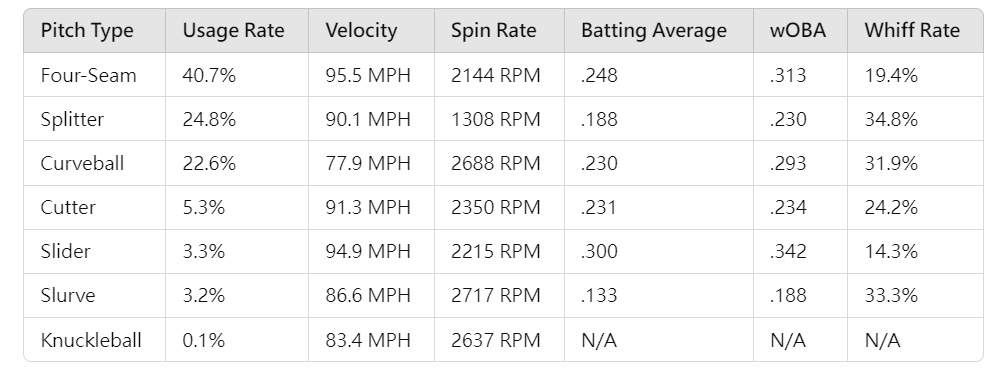
Here are the usage ratios of Yamamoto’s pitches against left and right-handed batters:
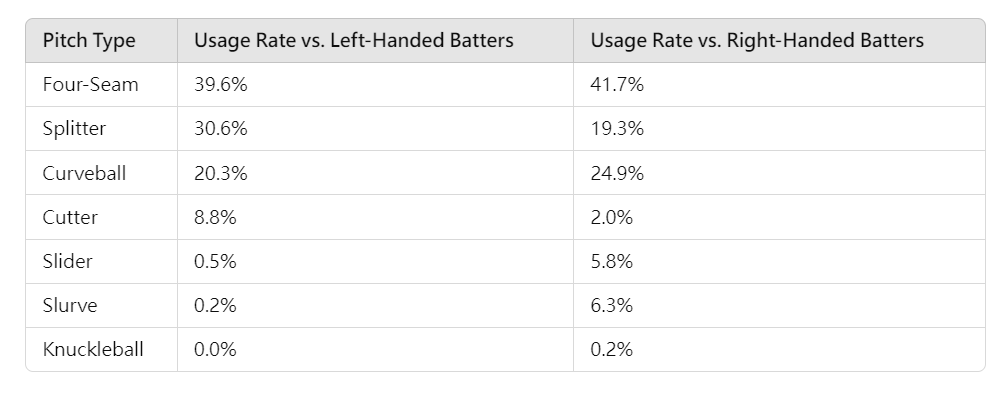
Overall, Yoshinobu Yamamoto’s usage of the four-seam fastball does not vary much between left and right-handed batters, but there is a significant difference in the other types of pitches used in combination with it.
When facing left-handed batters, Yamamoto primarily uses the splitter in conjunction with the four-seam fastball, and the curveball also accounts for 20.3% of his pitches. Additionally, he occasionally mixes in the cutter with these main pitches.
When facing right-handed batters, on the other hand, he mainly uses the curveball (24.9%) along with the fastball, though the splitter is also used significantly (19.3%). It is noteworthy that his pitch mix against right-handers is more diverse, with a more balanced distribution of his main pitches.
(Detailed Analysis of Yoshinobu Yamamoto’s Four-Seam Fastball)
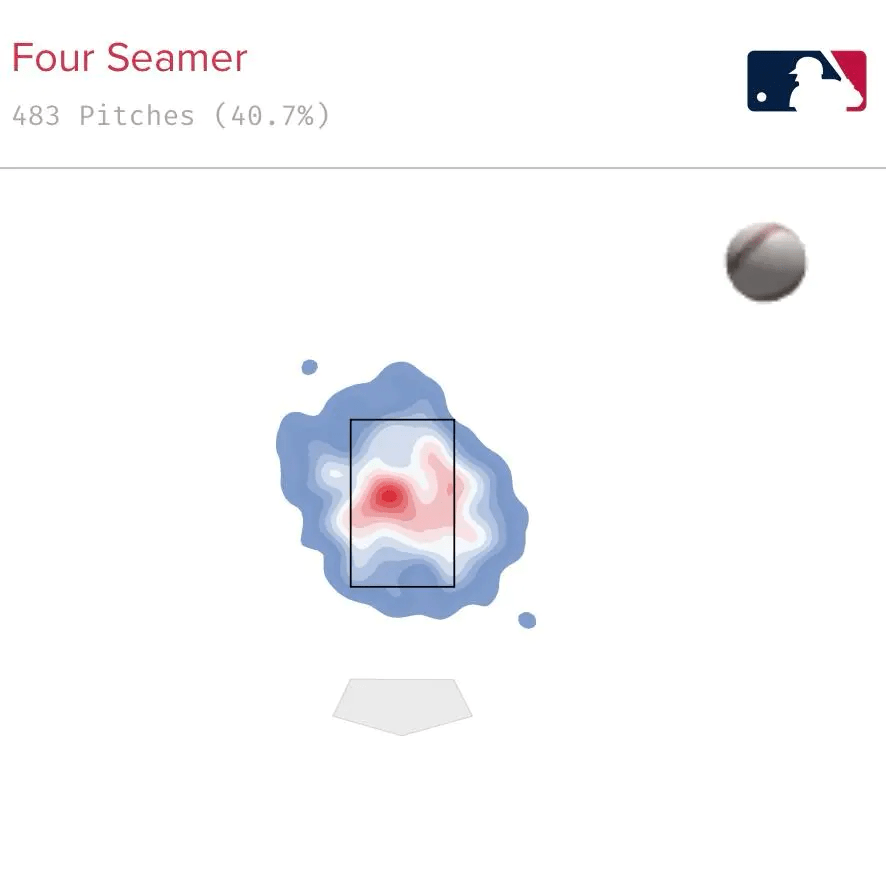
Yamamoto’s fastball velocity is above the MLB average for the season but is not particularly outstanding; however, his spin rate (2144 rpm) is somewhat lower than the league average. Importantly, his fastball has a high Run Value (PR 92), which benefits from his ability to utilize various locations within the strike zone, making it difficult for batters to consistently make solid contact.
Below is the distribution of Yoshinobu Yamamoto’s four-seam fastball pitch locations:
[Image source / Baseball Savant]
Additionally, Yoshinobu Yamamoto’s four-seam fastball is a pitch he relies on when he’s behind in the count, helping him overcome difficult pitch counts.
Typically, pitchers will use the four-seam fastball to regain control of the count when they are behind. However, in such scenarios (where the count is in the batter’s favor), batters tend to anticipate the pitcher’s mindset and attack accordingly, making it easier for batters to target pitchers who are behind in the count. However, Yamamoto’s data shows that although he uses the four-seam fastball 49.8% of the time when behind in the count, his overall batting average against is only .162, and he effectively suppresses extra-base hits (SLG .243). Therefore, it can be said that Yamamoto’s four-seam fastball turns a disadvantageous situation into an advantage for himself when he’s behind in the count.
(Detailed Analysis of Yoshinobu Yamamoto’s Splitter)
Yamamoto’s splitter can be considered his “winning pitch." This season, his performance with the splitter has been outstanding, and it’s the pitch he most commonly uses to resolve at-bats when he’s ahead in the count.
Overall, Yamamoto’s splitter performs well in terms of velocity, typically exceeding the league average by about 3-4 mph. Moreover, when throwing this pitch, he can precisely target the lower edge of the strike zone, making it difficult for batters to lock in on this pitch during an at-bat.
Below is the distribution of Yoshinobu Yamamoto’s splitter pitch locations:
[Image source / Baseball Savant]
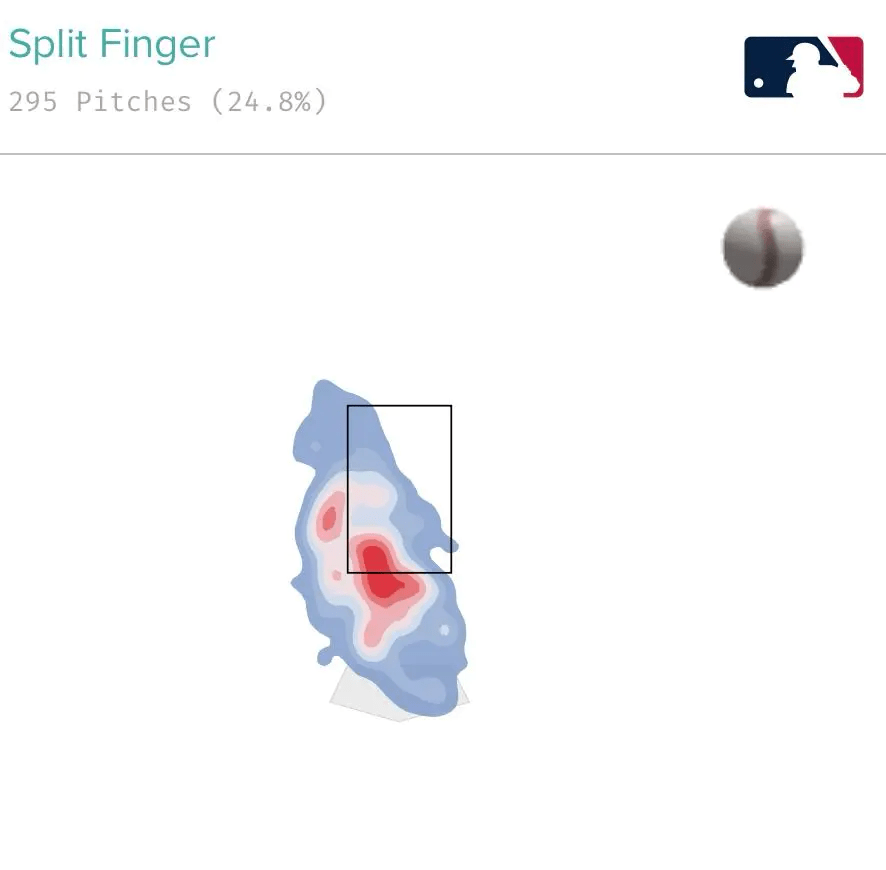
It’s worth noting that Yoshinobu Yamamoto’s splitter shows a significant difference in effectiveness against left-handed and right-handed batters. This season, against left-handers, his splitter has a batting average against of only .140 and a slugging percentage against of .180, effectively baffling left-handed hitters. However, against right-handers, the batting average against jumps to .267, with a slugging percentage of .500, significantly reducing its effectiveness compared to when facing left-handed batters.
(Detailed Analysis of Yoshinobu Yamamoto’s Curveball)
Yamamoto’s curveball is another pitch he frequently uses in combination with his fastball. However, this year, his curveball has not been particularly suppressive against batters, with a batting average against of around .230, which is about the league average, and it has also been relatively prone to being hit for extra bases (isolated power rate of .180).
While overall, Yamamoto’s curveball exhibits an impressive spin rate (averaging 2688 rpm), making it notable among other pitchers in the league, and its significant drop can greatly challenge batters in judging the pitch’s entry point. However, the effectiveness of Yamamoto’s curveball is limited by a tendency to pitch it too high, which has prevented it from performing as well as expected.
Below is the distribution of Yoshinobu Yamamoto’s curveball pitch locations:
[Image source / Baseball Savant]
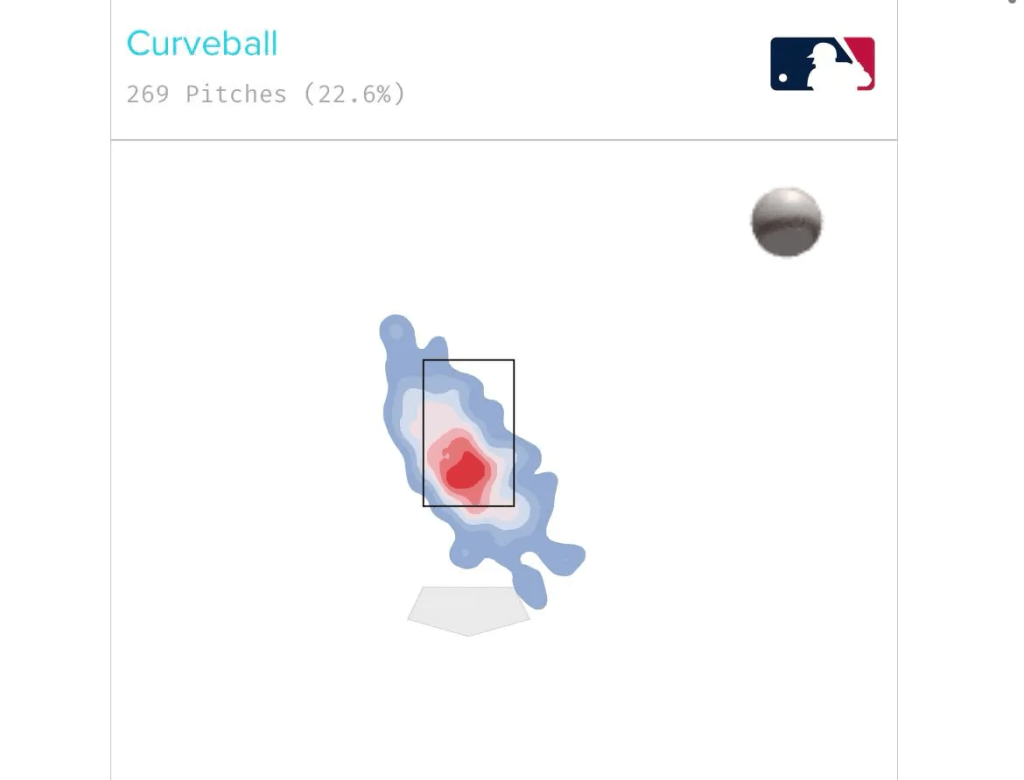
Overall, Yoshinobu Yamamoto’s curveball is highly effective against left-handed hitters; this season, his curveball has held left-handers to a batting average of only .182 and a slugging percentage of .227. However, against right-handers, the batting average rises to .256, with a slugging percentage of .513, and his ability to induce swings and misses is lower than against left-handers.
(Analysis of Yoshinobu Yamamoto’s Other Pitches)
In addition to the four-seam fastball, splitter, and curveball, Yoshinobu Yamamoto has a variety of other pitches in his arsenal.
Notably, Yamamoto’s slider, which was a key pitch during his time in Japanese professional baseball, has been sparingly used since his move to MLB. Despite its infrequent use this season, the slider has held batters to a .143 average and has been effective in striking out batters when Yamamoto is ahead in the count. This performance is largely due to the high spin rate of his slider (2717 rpm), and his ability to keep the pitch low and outside against right-handers, making it difficult for hitters to effectively time their swings.
Yamamoto also utilizes other “fastball-type" pitches, such as the cutter and shuuto. Although these pitches are not frequently used at this stage of his career, having a variety of fastball options helps prevent opponents from predicting his pitch sequences effectively.
Moreover, the versatility of Yamamoto’s pitch arsenal allows him to easily switch to different pitches if one is not performing well during a game.
⚾️ Detailed Analysis of Yoshinobu Yamamoto’s Control and Catcher Pairings ⚾️
(Control Performance Analysis)
Overall, Yoshinobu Yamamoto is a pitcher with excellent control. This strength was fully exhibited during his time in Japanese professional baseball and has continued in MLB.
From 2020 to 2023, Yamamoto won the Pacific League strikeout title for four consecutive seasons. During these years, not only did he pitch a substantial number of innings, but his strikeouts per nine innings (K/9) were consistently above 9.0, and he rarely issued walks.
Below are his strikeout rates (K%), walk rates (BB%), and K/BB ratios from 2017 to 2024:
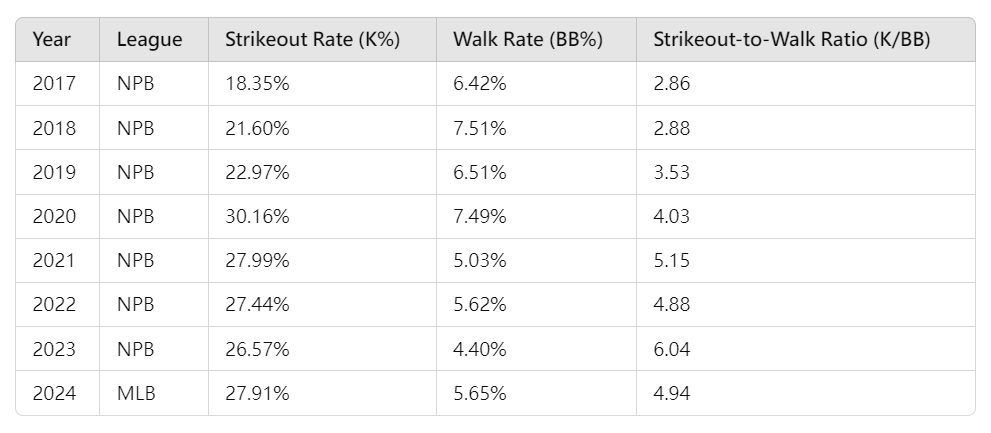
Since 2018, Yoshinobu Yamamoto’s first full professional season, his annual strikeout rate (K%) has consistently been above 20.00%, and since 2020, his strikeout-to-walk ratio (K/BB) has been above 4.00 every year. Notably, in the 2023 season, Yamamoto’s K/BB ratio reached 6.04, the best of his career, which played a significant role in the Dodgers deciding to sign him to a substantial contract.
This season, Yamamoto’s K/BB ratio with the MLB Dodgers is nearly 5.00, showing excellent overall control performance, and his overall strikeout and walk rates are not far off from his performance in the Japanese professional league. This indicates that Yamamoto has maintained a strong level of control since transitioning from NPB to MLB, showing real development in his abilities.
Overall, Yamamoto is a pitcher who aggressively targets the strike zone. This year, he has thrown 54.0% of his pitches within the strike zone, about 2%-3% higher than the MLB average (51.4%). Notably, this season, batters have swung at 31.3% of his pitches outside the strike zone (compared to the MLB average of 28.2%) and 62.9% of his pitches inside the strike zone (compared to the MLB average of 65.8%).
This reflects Yamamoto’s high precision and challenging pitch placement, as he tends to keep pitches on the edges of the strike zone. As a result, many of his pitches outside the zone are tempting to hitters, and pitches within the zone often make hitters believe they might move out of the zone, complicating their batting strategies.
(Catcher Pairing Analysis)
This season, Yamamoto has paired with two catchers: Austin Barnes, who is more defensively oriented, and Will Smith, who has strong offensive capabilities. During his time with the Orix Buffaloes in NPB, Yamamoto frequently paired with catcher Kenya Wakatsuki, winning several ‘Best Battery’ awards in the Pacific League.
This season, Yamamoto’s pitching stats with Barnes (24 1/3 innings, ERA 1.50) have been superior to those with Smith (50 1/3 innings, ERA 3.60), particularly in terms of suppressing opposing batters’ OPS (0.547 with Barnes vs. 0.659 with Smith). However, his control stats show a higher K/BB ratio with Smith (6.11) compared to Barnes (3.63).
Despite Barnes’ overall poorer ‘framing’ metrics (-2) compared to Smith’s (1), Yamamoto’s control performance is better with Smith. This could be linked to Yamamoto’s higher usage of curveballs when paired with Barnes, as curveballs are generally not used to attack the strike zone aggressively. Hence, more walks occurred in the games where Barnes was catching.
This article will be followed by another analysis of Yamamoto, discussing his approach to different batters and detailing his pitching strengths and weaknesses, concluding with a summary.
Sources:
- Taiwan Baseball Wiki
- Exchange Rates Org (for TWD/USD exchange rate)
- Fangraphs
- Baseball Reference
- ET Today Sports
- Baseball Savant
- Yahoo Sports Taiwan
- pitch logic
- ptt baseball
- MLB official site
- Wikipedia
 A Fan's MLB Insight
發表留言