In the previous article on San Diego Padres’ starting pitcher Yu Darvish for Game 1 of the overseas series, I covered his biography, pitching characteristics, strengths, and weaknesses. This article will analyze the types of pitches Darvish employs, his performance in various situations, and the expected lineup adjustments from the Los Angeles Dodgers.
(3) Analysis of Yu Darvish’s Pitch Types and Performance
Yu Darvish’s diversity in pitch types has always been a hallmark of his style. In fact, he has been reported by American sports media in 2019 to be the only major league pitcher with more than 10 different types of pitches.
Here are the nine pitch types Darvish used last season (2023), sorted by usage percentage (Data from Baseball Savant):
- Sinker (18.6%): Average velocity of 94.3 MPH and average spin rate of 2272 rpm.
- Sweeper (18.5%): Average velocity of 82.4 MPH and average spin rate of 2792 rpm.
- Slider (17.5%): Average velocity of 85.7 MPH and average spin rate of 2828 rpm.
- 4-Seam Fastball (16.6%): Average velocity of 94.7 MPH and average spin rate of 2406 rpm.
- Cutter (9.1%): Average velocity of 90.9 MPH and average spin rate of 2603 rpm.
- Split Finger (7.8%): Average velocity of 89.2 MPH and average spin rate of 1450 rpm.
- Knuckle Curve (6.6%): Average velocity of 79.3 MPH and average spin rate of 2769 rpm.
- Curveball (5.1%): Average velocity of 72.3 MPH and average spin rate of 2647 rpm.
- Changeup (0.1%): Average velocity of 82.3 MPH and average spin rate of 1198 rpm.
The usage of these pitches shows a close balance among his top four pitches, ranging from 16% to 19%, while the next five pitches are used between 5% and 10%, except for the rarely used changeup.
Darvish’s pitch performance varied last year; although the velocity of his fastballs decreased from the previous year, the spin rates for his breaking and offspeed pitches improved. The overall spin rate remains a strong point in his repertoire.
Darvish tends to use fastballs more against right-handed hitters (50.4%) and breaking pitches more against left-handed hitters (49.7%). He also uses offspeed pitches more against left-handers (10.6%) than right-handers (4.3%).
However, last season showed vulnerabilities in Darvish’s pitch arsenal. Against left-handers, his offspeed pitches allowed a high batting average of .311 and a slugging percentage of .541. Against right-handers, these pitches allowed a batting average of .228 and a slugging percentage of .337, indicating a potential area for opponents to exploit.
(4) Yu Darvish’s Performance in Various Situations
While Darvish generally performs better against right-handed hitters (.209/.276/.353) compared to left-handers (.230/.300/.393), recent years (2021-2023) have seen less disparity, with 2022 featuring better suppression against left-handers. Last year, however, his effectiveness against left-handers declined (OPS .799).
His performance in September has been impressive, with a record of 17 wins and 15 losses, an ERA of 3.26, and an OPS against of .603. However, July has historically been his worst month, with an OPS against of .739 and an ERA of 4.54.
Pitching ahead in the count, Darvish excels with an OPS against of .413 and a batting average against of .163. However, when behind in the count, his OPS against jumps to .962 and a batting average against of .274, highlighting a critical area for improvement.
(5) Predicting the Dodgers’ Lineup Against Yu Darvish (This section is written from the perspective of how the Dodgers will lineup against Darvish)
Here is the data on the current Dodgers hitters’ career performance against Yu Darvish (Source: ESPN)
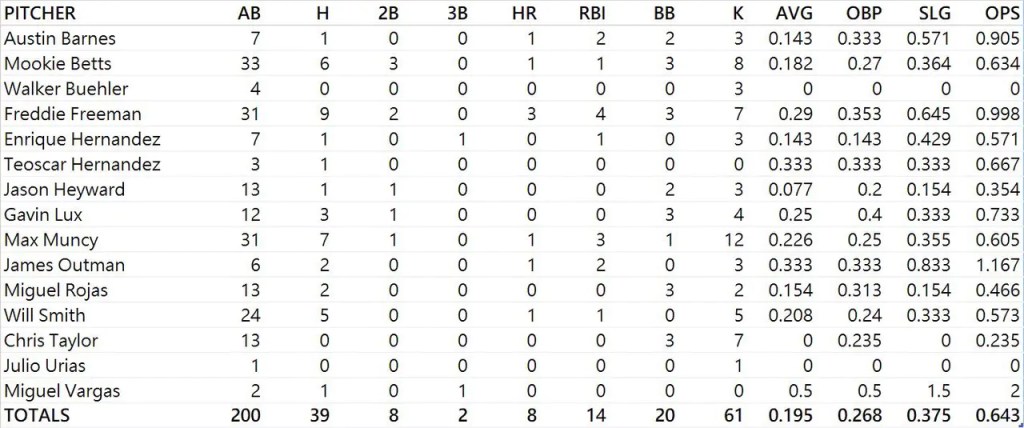
From the data, it’s evident that Yu Darvish has performed well against the current Dodgers lineup, even managing to subdue strong hitters like Mookie Betts, Will Smith, and Max Muncy in many of their encounters. However, since these players are key hitters for the Dodgers, they are still expected to be included in the starting lineup for Game 1 of the overseas series in Korea.
Given Darvish’s lesser suppression against left-handed hitters last season, the Dodgers are likely to include more left-handed batters in their lineup to counter him. Considering the Dodgers have several potent left-handers, they have room to make such adjustments. They might also place stronger hitters in scoring positions towards the end of the lineup to enhance overall scoring efficiency.
Shohei Ohtani, a recent Japanese addition to the Dodgers, has never faced Darvish before; their matchup in Game 1 of the Korea series will likely be a significant highlight.
Predicted Dodgers lineup for the first game:
- SS Mookie Betts
- DH Shohei Ohtani
- 1B Freddie Freeman
- C Will Smith
- 3B Max Muncy
- CF James Outman
- RF Teoscar Hernandez
- 2B Gavin Lux
- LF Andy Pages (likely included due to his strong performance in spring training and expected to be on the opening day roster).
In summary, Yu Darvish is a formidable pitcher with diverse pitching styles, control, strikeout ability, and the capacity to suppress hitters. Despite a decline in some areas last season and more noticeable weaknesses, it remains to be seen whether he can regain his form in the opening game against the power-hitting Dodgers lineup, which includes many strong left-handed hitters. This matchup is highly anticipated by MLB fans.
Sources:
Baseball Savant
Liberty Times Sports
Baseball Reference
ESPN
 A Fan's MLB Insight
發表留言